ATS is a community of supporters, innovators, and champions of possibility united by one mission: transforming Israel and the world through science and discovery.
For more than 100 years, the Technion has been Israel's technological engine and leading driver of innovation, technology, and entrepreneurship, transforming ideas into impact.
Step inside Israeli innovation at the David and Janet Polak Visitors Center. Experience our 360° immersive movie and tech exhibition. Open to individuals and groups.
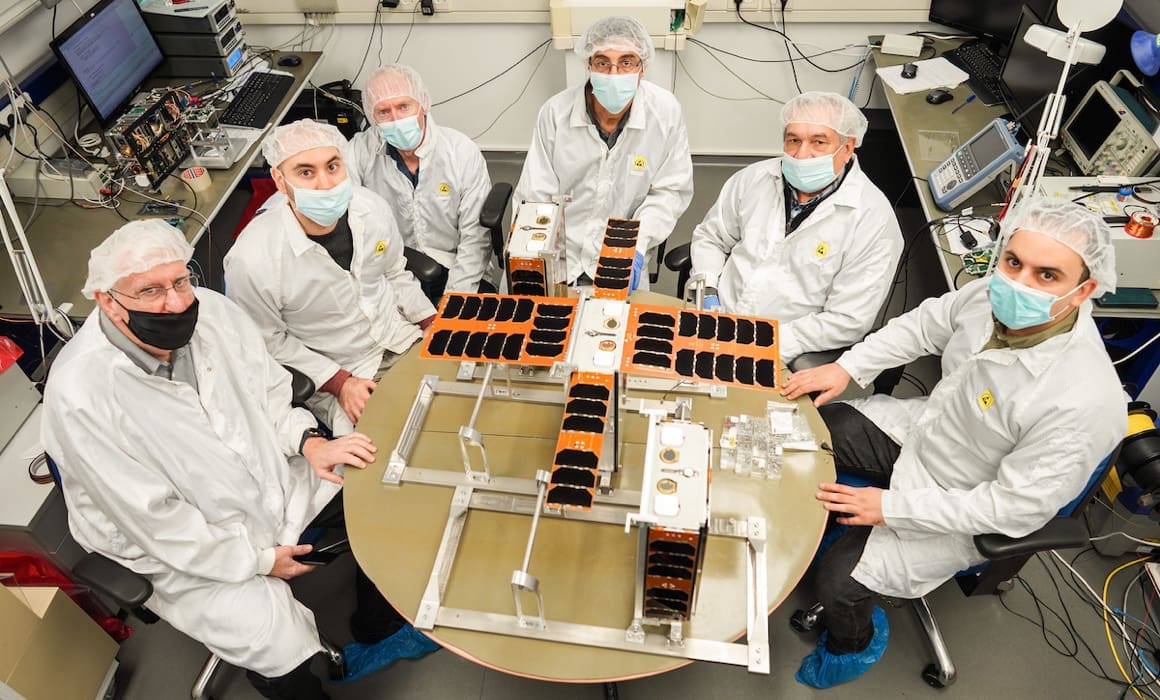
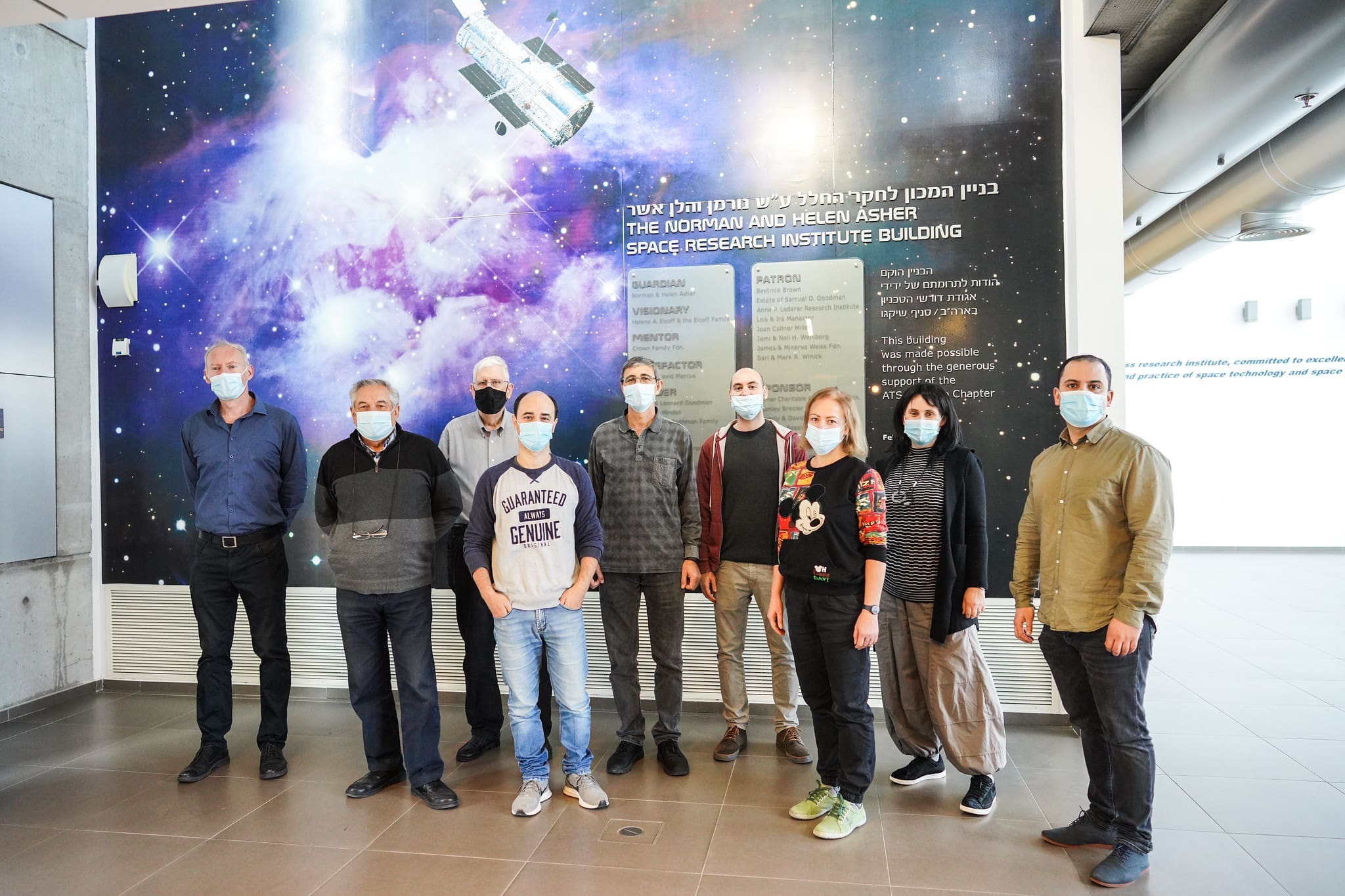
Pictured above: Engineers & researchers from the Asher Space Research Institute at Technion – Israel Institute of Technology with the nanosatellites
After a two-day mechanical delay, the autonomous satellite group developed at the Technion as part of the Adelis-SAMSON project was launched into space on Monday, March 22. The satellites were launched from the Baikonur Cosmodrome in Kazakhstan – the world’s first spaceport, and the first site to send a human into space (April 1961, Yuri Gagarin).
Four hours and twenty minutes after the launch, the Adelis-SAMSON satellites entered orbit. Thirty minutes later, they “woke up” and began operating. Their first communication with the control center at the Technion is expected to come this afternoon.
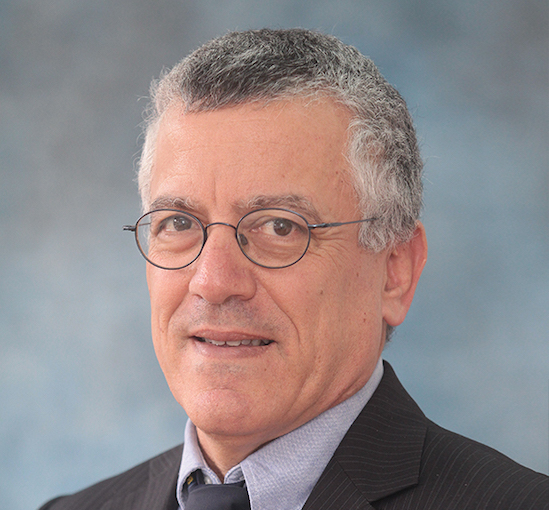
Among those watching the live broadcast from the control center at the Asher Institute for Space Research were Technion President, Professor Uri Sivan; Vice President and CEO Professor Boaz Golany; Vice President for Foreign Relations and Resource Development Professor Alon Wolf; Head of the Asher Institute for Space Research Professor Yoram Rosen; and the people who have been accompanying the project since its inception, headed by Professor Pini Gurfil of the Faculty of Aerospace Engineering and the Asher Institute for Space Research.
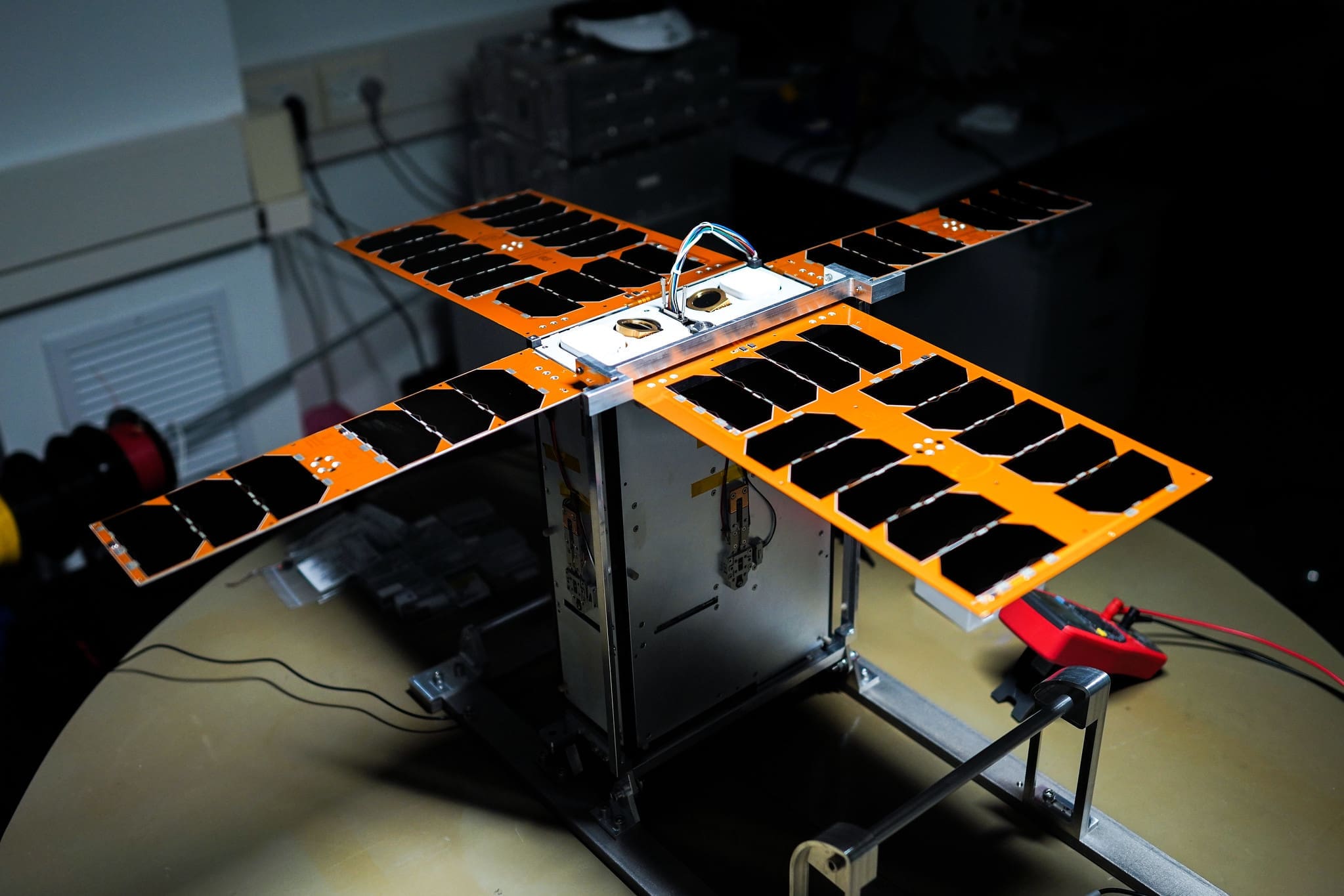
One of the nanosatellites
“The Adelis-SAMSON project is a wonderful and exciting example of the successful integration of science and technology and the translation of innovative ideas into effective systems that contribute to humanity,” said President Sivan. “Scientific and technological breakthroughs require multidisciplinary research and close collaboration between academia and industry, and this is what has led the project to this important day. Each time that you look up at the sky, remember that the Technion has succeeded again in reaching space.
“The current project continues a Technion tradition that began in 1998 with the successful launch of the Gurwin-TechSat II,” added the Technion President. “That satellite operated in space for more than 11 years, a record time for academic activity in space. The launch of Adelis-SAMSON is a dramatic moment that we have been waiting nine years for and will follow closely. I sincerely thank our partners at the Adelis Foundation, the Goldstein Foundation, the Israel Space Agency, and the Israel Aerospace Industries for helping us make this project a reality.”
“This morning’s launch was accompanied by tremendous excitement,” said Prof. Gurfil. “A basic study over the course of many years, combined with advanced Israeli technology, allows Israel to take an important step forward in the field of micro-satellites. You could compare the innovation of nanosatellites to switching from the computer to the cellphone.
The mission control center at Technion’s Asher Space Research Institute
“The Adelis-SAMSON project demonstrates a new concept in nanosatellites and will enable many operations to be carried out that have been reserved until now for large and expensive satellites,” he continued. “This is a leap in the field of miniature satellites in the capabilities of the Technion and for the entire State of Israel, and one which will make the Technion a global pioneer in the fields of location and communication, with diverse applications including missing persons detection, search and rescue, remote sensing, and environmental monitoring.”
The trio of satellites will move in space in an autonomous structure flight. IN other words, they will move in coordination with each other without the need for guidance from the ground. The band will be used to calculate the location of radiating sources on Earth, a technology that will be applied for locating people, planes, and ships. Each of the three miniature satellites (CubeSats) weighs about 17 ½ lbs., and is replete with measuring instruments, antennae, computer systems, control systems, navigation devices, and a unique and innovative propulsion system. The satellites will travel at an altitude of 373 mi., from which it will detect high precision signals from Earth. The signals will be transmitted to a special mission control center, developed by IAI’s Elta plant, inside the Asher Space Research Institute.
The unique developments of these national satellites were made possible by an exceptional collaboration between academia and industry. The satellites’ special propulsion system, based on krypton gas, is the first of its kind in the world to operate on a tiny satellite. The digital receiver was developed by ELTA, and the directional control system was developed at IAI’s plant in collaboration with Technion researchers. In addition to the propulsion system, the satellites will accumulate energy through solar panels that also serve as wings that will control, if necessary, the flight of the formation without the use of fuel, using gravity and air resistance in the atmosphere. The satellites’ fuel consumption is less than a gram per day per satellite. This achievement is the result of ten years of research that preceded the launch.
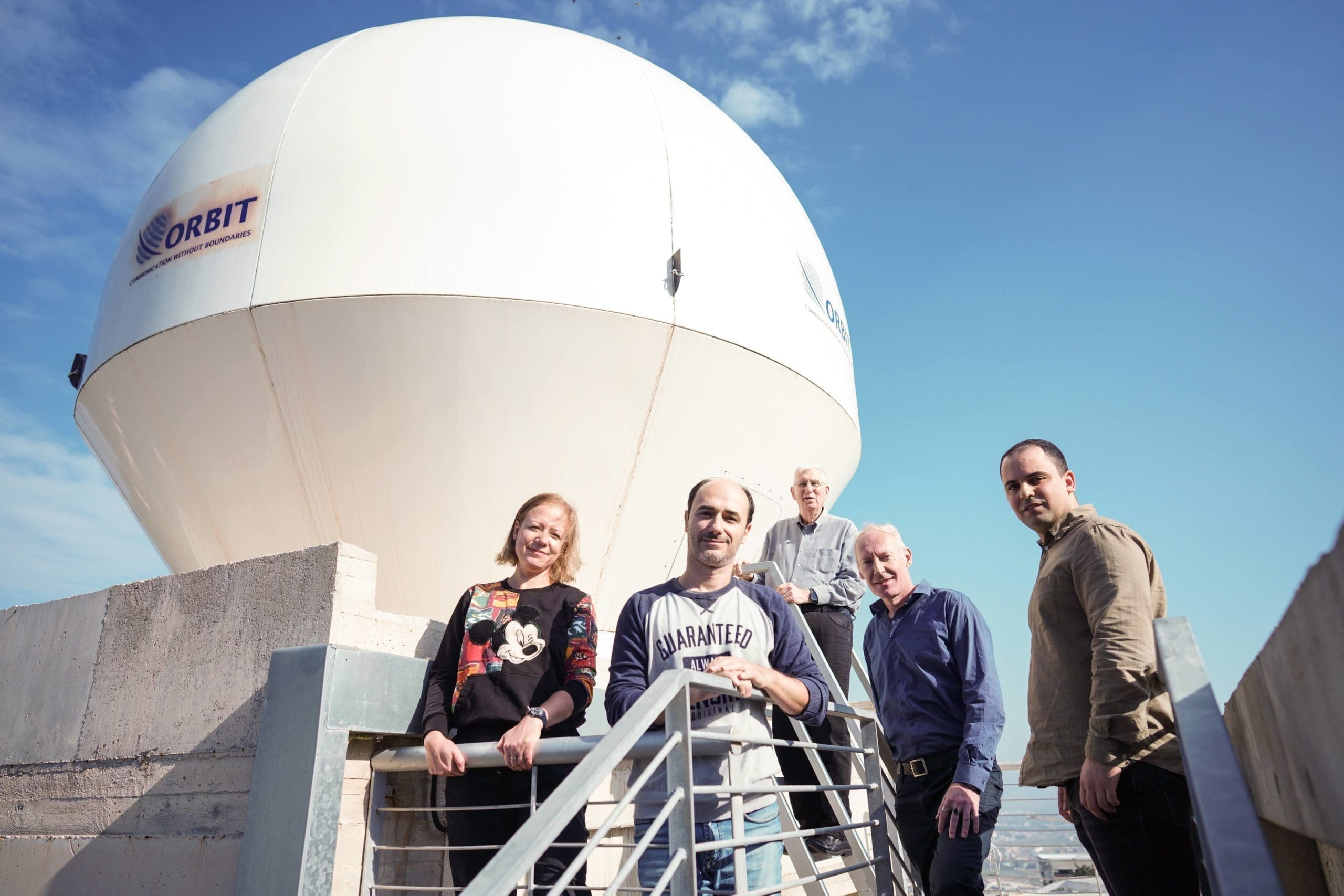
The Adelis-SAMSON project’s team with Prof. Pini Gurfil of the Faculty of Aerospace Engineering (first from left)
Credit: Nitzan Zohar, Technion, Spokesperson’s Office
Each of the nanosatellites is fitted one of the most complex digital receivers ever designed. The system for processing the information on the satellite and the algorithms that will keep the structures flying is among the first of their kind in the world, and support the simultaneous autonomous operation of all three satellites. The navigation system includes two GPS receivers for autonomous navigation. The system by which the three nanosatellites will communicate with each other, as well as with the ground station, will be operated at three different frequencies – a significant challenge that was resolved in the current project. A dedicated frequency will be used to transmit information to Earth through broadband.
The continuous monitoring of the satellites and the collection of data that will be transmitted will take place at the Adelis-SAMSON control station inaugurated at the Technion in 2018. Built with the support of the Adelis Foundation, it contains an array of antennas made by Israeli company Orbit.
“For many years, space and space technology have been considered the domain of superpowers, and too grand, expensive, and complex for small countries. Israel has demonstrated that this is not the case, and it is vital that it is a member of the elite international space community,” said Mrs. Rebecca Boukhris, Adelis Foundation Trustee. “The rapid development of the space industry in Israel is essential. This project is unique for the Adelis Foundation in that it symbolizes the spirit, genius, and strength of Israel. In effect, it highlights the technological and scientific brilliance of Israel and positions our country on the world map in the field of aerospace, and all this on a modest budget within the university setting of Technion. The Adelis Foundation considers itself as sowing the seeds of the future and hopes that this project will be the first of many more. We hope that many other small and brilliant projects will take the Adelis-SAMSON mission as an example and develop a new ingenious space mission for the benefit of the State of Israel.”
“The field of nanosatellites has been gaining momentum recently with the number of launches doubling every year,” said Avi Blasberger, director of science at the Israeli Space Agency. “The cost of developing and launching multi-functioning satellites is significantly lower than those of regular satellites. In the not too distant future, networks will include thousands of nanosatellites across the Earth and will enable high-speed internet communication at a significantly lower cost.”
“We see great importance in our collaboration with the Technion to promote academic research and future technologies in the field of space,” said IAI President & CEO Boaz Levy. “IAI, ‘Israel’s National Space House,’ sees high value in its connection to academia on the business and the technological levels to advance Israel’s continued innovation and leadership in the field of space. This partnership promotes the development of the entire ecosystem and IAI is proud to join forces in this innovative and groundbreaking project.”
Among the many partners in Technion’s Adelis-SAMSON project are the Adelis Foundation, the Goldstein Foundation, and the Israeli Space Agency in the Ministry of Science and IAI. From the Technion, many researchers from the Asher Institute for Space Research participated in the project, including Avner Kedar, Hovik Aglarian, Dr. Vladimir Balanov, Evyatar Adlerman, Yaron Oz, Maxim Rubanovich, Margarita Shamis, Yulia Koneivsky, Tzachi Ezra, and Dr. Alex Fried, and many students over the years.
More About Pini Gurfil
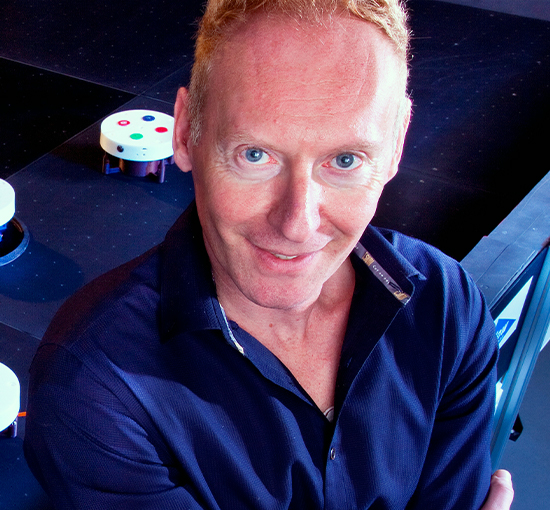
Professor Pini Gurfil is the holder of the Shirley and Burt Harris Chair, head of Technion’s Norman and Helen Asher Space Research Institute (ASRI), and the director of the Distributed Space Systems Lab (DSSL) in the Faculty of Aerospace Engineering at the Technion. He is also the principal investigator of the Adelis-SAMSON satellite project.
Artificial intelligence is not simply changing higher education — it is detonating old assumptions about how students learn and how professors teach. As universities worldwide grapple with how to respond, the Technion is working to confront the questions head-on. Here, AI is not treated as a threat but a catalyst, prompting careful reexamination at every […]
Go
Article
Europe Is Betting on Technion Innovation
September 04, 2026
Every year, the European Research Council (ERC) identifies some of the world’s most promising early-career researchers and gives them the freedom to pursue bold ideas. This year, two of those ideas came from the Technion – Israel Institute of Technology. From cancer research to artificial intelligence (AI), breakthroughs that shape the future often begin with […]
Go
In The News
Cornell Tech’s Tree Canopy Project Builds a Cooler New York City
August 11, 2026
Despite New York City Mayor Zohran Mamdani’s past calls to boycott Cornell Tech because of its partnership with Israel’s Technion-Israel Institute of Technology, city officials and Jewish community leaders on Wednesday announced a $250,000 investment in a Cornell Tech research initiative aimed at expanding New York City’s tree canopy to combat rising temperatures. New York City Council Speaker Julie Menin, the first Jewish woman to hold the post, and other officials unveiled the funding for Cornell Tech’s Urban Tech Hub at the Jacobs Technion-Cornell Institute on Roosevelt Island. The grant will launch the Generative Tree Canopy Project, which will use…
Go
Love Israel and Science?
Stay on top of the latest breaking scientific discoveries from Israel and the Technion. Subscribe to the ATS newsletter.
Manage Consent
To provide the best experiences, we use technologies like cookies to store and/or access device information. Consenting to these technologies will allow us to process data such as browsing behavior or unique IDs on this site. Not consenting or withdrawing consent, may adversely affect certain features and functions.
Functional
Always active
The technical storage or access is strictly necessary for the legitimate purpose of enabling the use of a specific service explicitly requested by the subscriber or user, or for the sole purpose of carrying out the transmission of a communication over an electronic communications network.
Preferences
The technical storage or access is necessary for the legitimate purpose of storing preferences that are not requested by the subscriber or user.
Statistics
The technical storage or access that is used exclusively for statistical purposes.The technical storage or access that is used exclusively for anonymous statistical purposes. Without a subpoena, voluntary compliance on the part of your Internet Service Provider, or additional records from a third party, information stored or retrieved for this purpose alone cannot usually be used to identify you.
Marketing
The technical storage or access is required to create user profiles to send advertising, or to track the user on a website or across several websites for similar marketing purposes.