Why the Perfect Pitch is Your Biggest Mistake
September 23, 2026





























The Technion’s story has been intertwined with Israel’s for more than a century, from laying the foundations for a new nation to shaping its future.

Step inside Israeli innovation at the David and Janet Polak Visitors Center. Experience our 360° immersive movie and tech exhibition. Open to individuals and groups.
Learn More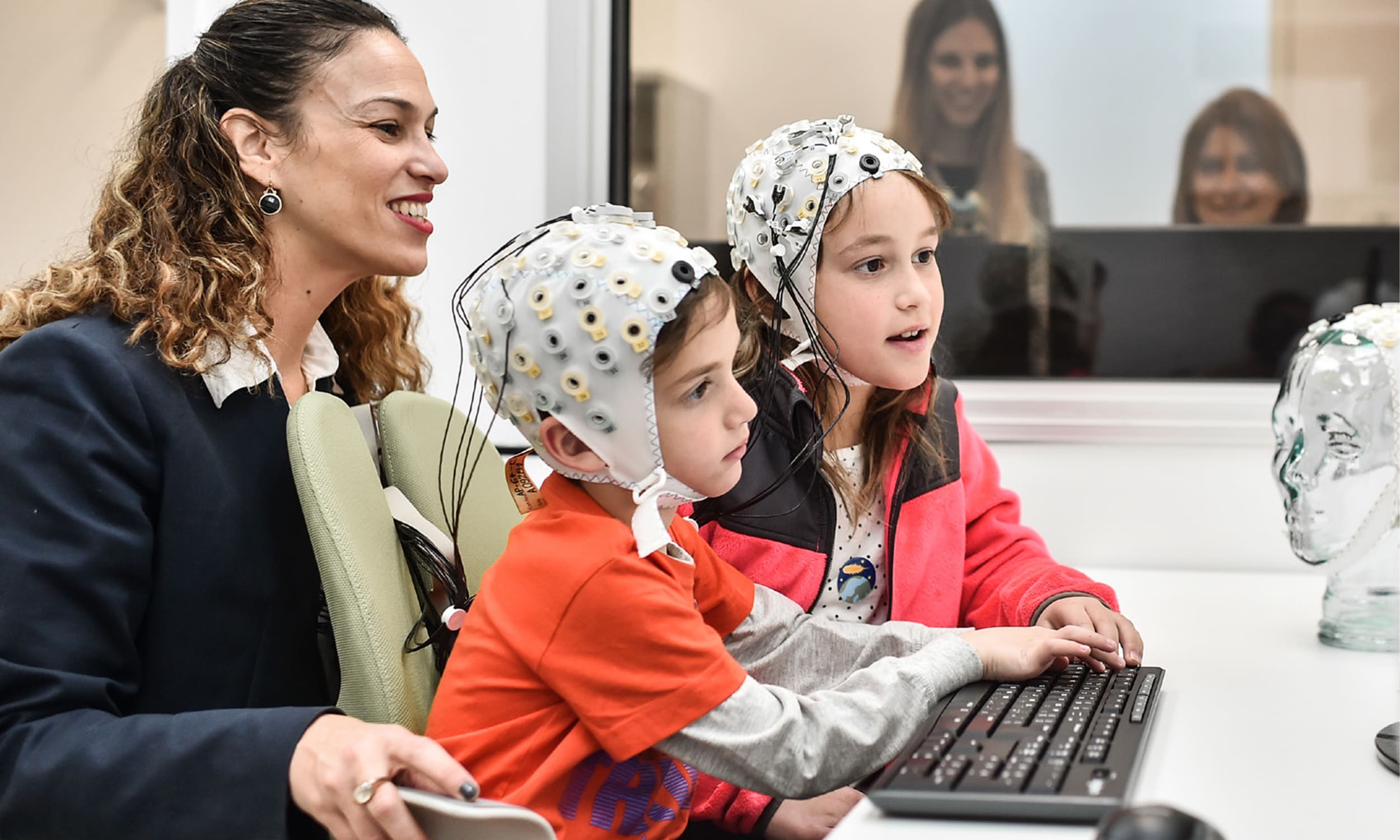
With Assistant Professor Tzipi Horowitz-Kraus
Assistant Professor Tzipi Horowitz-Kraus’ lab is equipped with a state-of-the-art electroencephalogram (EEG) and a waiting room strewn with dolls, crayons, and toys. The toys make young children feel comfortable; the EEG assesses whether those same kids are bound for reading difficulties.
“Reading is not a normal activity for us humans,” says Prof. Horowitz-Kraus, director of the Educational Neuroimaging Center in the Technion Faculties of Education in Science and Technology, and Biomedical Engineering. “When you don’t have any problems with it, you think it’s super easy and you can capture it in the snap of a finger. But for many kids, reading is not an intuitive process.”
That’s where the EEG and other sophisticated neuroimaging tools come in. By attaching electrodes to the head, Prof. Horowitz-Kraus is getting a look inside the children’s brains. What happens in there when a child struggles to read? What happens even beforehand, when the child is not reading but just hearing the words? Her work is unique in using neuroimaging to understand the biology that underlies reading ability. “What regions of the brain does it involve? What networks does it affect? Reading is not just looking at the word and saying it out loud.”
Prof. Horowitz-Kraus had two younger brothers who wrestled with reading problems. Determined to find the neurobiological causes for reading difficulties, which affect about 15% of the population in the U.S., she is trying to isolate the brain circuitry necessary for fluent reading. She works with teens and children as young as four. The younger ones “don’t know how to read yet, but the infrastructure for doing so should be there.”
People struggle with reading for a variety of biological and environmental reasons including psychiatric disorders, dyslexia, and ADHD, to name a few. Reading can be inhibited because a child was born prematurely or the parent suffers from depression. As these children read or listen to a story, Prof. Horowitz-Kraus notes, different areas of the brain light up than those in the brains of competent readers. Getting to the bottom of why a child might have reading problems can help scientists and even educators tailor their solutions.
Thanks to a National Institutes of Health (opens in a new tab) (NIH) grant to the Technion and Cincinnati Children’s Hospital Medical Center, where she is an associate professor, she has been able to focus on the importance of “executive functions” of reading. These functions are a set of cognitive abilities such as attention, memory, and information processing, and the ability to plan, learn from mistakes, and exhibit self-control. If these functions do not work well, then reading is difficult. If you cannot remember the sound made by “th” or quickly recognize the sound that the letter “C” makes, or sit still long enough to think about all of it, then you cannot read.

Ten years ago, the main focus on reading disability was language, visual, and semantics. Now we know there are many subskills, and that we may be able to train specific executive functions so they will bypass the core reading problems. This is the pioneering part of my work.”
Assistant Professor Tzipi Horowitz-Kraus