Video

Why the Perfect Pitch is Your Biggest Mistake

September 23, 2026

Go
Video

When the Newsroom Meets the Algorithm

September 18, 2026
Go
disease detection
Article

A Breathalyzer Test for Cancer?

September 17, 2026
Go
Podcast

Everything In-House

August 11, 2026
Go
disease detection
Article

A Breathalyzer Test for Cancer?

September 17, 2026
Go
artificial intelligence health care
Article

Europe Is Betting on Technion Innovation

September 04, 2026
Go
Chatbot | American Technion Society | Donate to Israel
In The News

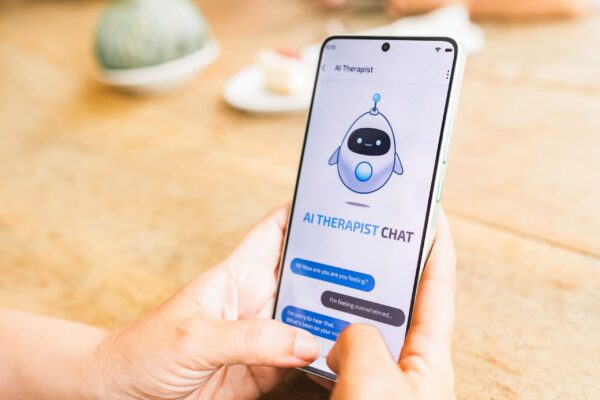
Can AI Chatbots Support Mental Health?

August 07, 2026
Go
Cancer Research | American Technion Society | Donate to Israel
In The News

Advancing Cancer Research Through Discovery

August 04, 2026
Go
AI in education
Article

Rethinking Education in the Age of AI 

September 25, 2026
Go
artificial intelligence health care
Article

Europe Is Betting on Technion Innovation

September 04, 2026
Go
Tree Canopy | American Technion Society | Donate to Israel
In The News

Cornell Tech’s Tree Canopy Project Builds a Cooler New York City

August 11, 2026
Go
Wildfire detection | American Technion Society | Donate to Israel
In The News

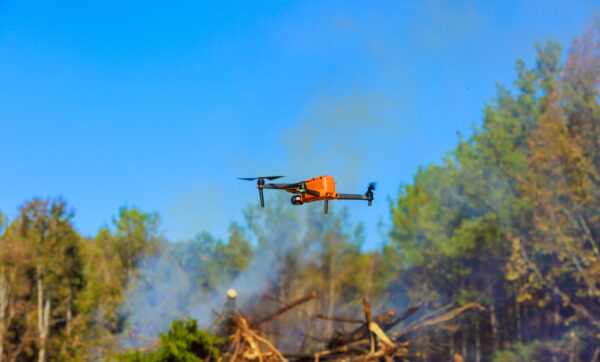
Wildfire Detection Takes Flight With AI-Powered Drones

August 04, 2026
Go
strength in every step | American Technion Society | Donate to Israel
Article

Strength in Every Step: Recovery, Resilience, and a Walk to Remember

August 21, 2026
Go
Student Resilience | American Technion Society | Donate to Israel
Article

Never Too Late for a New Challenge

August 17, 2026
Go
coexistence | American Technion Society | Donate to Israel
In The News

The Technion’s Model of Coexistence

August 07, 2026
Go
Sirens | American Technion Society | Donate to Israel
Article

When the Sirens Sound

August 07, 2026
Go
Reuven Aronashvili
Video

From a Poor Town to Leading Paradigms in Cyber

September 25, 2026
Go
earthquake rescue | American Technion Society | Donate to Israel
In The News

Israeli Drones Aid Earthquake Rescue Efforts in Venezuela

July 08, 2026
Go
No GPS or Communication Drones flying in the background as a soldier's shadowy silhouette fills the foreground
Video

When GPS Fails, This Drone Keeps Going

June 10, 2026
Go
Article

Technion Innovations: Safeguarding Israel and the World

May 28, 2026
Go
Article

Seeds of a New Community

September 08, 2026
Go
Tree Canopy | American Technion Society | Donate to Israel
In The News

Cornell Tech’s Tree Canopy Project Builds a Cooler New York City

August 11, 2026
Go
Wildfire detection | American Technion Society | Donate to Israel
In The News

Wildfire Detection Takes Flight With AI-Powered Drones

August 04, 2026
Go
Energy Tower | American Technion Society | Donate to Israel
In The News

The Energy Tower: A Vision Ahead of Its Time Finds New Life

July 08, 2026
Go
AI in education
Article

Rethinking Education in the Age of AI 

September 25, 2026
Go
Podcast

Predictions from The Himalayas

September 17, 2026
Go
Student Resilience | American Technion Society | Donate to Israel
Article

Never Too Late for a New Challenge

August 17, 2026
Go
Video

Technion: The Vision to Do Good

August 17, 2026
Go
Video

Technion: The Vision to Do Good

August 17, 2026
Go
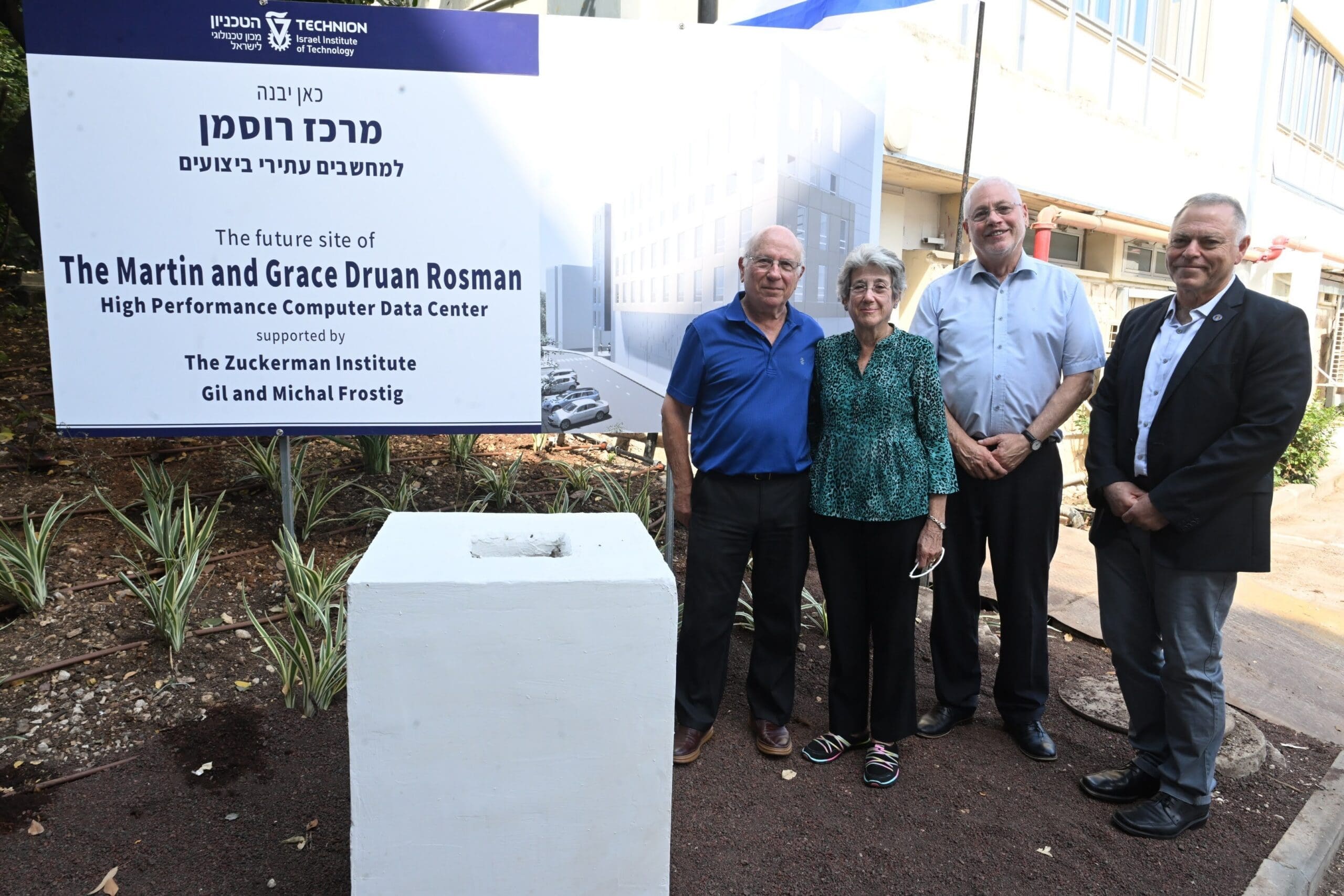
From left: Dr. Martin Rosman; Grace Druan Rosman; Technion President Prof. Uri Sivan; and Dr. Rafi Aviram, executive vice president and director general of the Technion, at the cornerstone ceremony for the Martin and Grace Druan Rosman High-Performance Computer Data Center building. | American Technion Society | Donate to Israel
Article

A Vision Built Around Students

June 29, 2026
Go
1912 - Today | Technion flag with Israeli flag | Donate to Israel | Technion University
Video

1912 to Today: The Institution That Helped Build Israel

June 10, 2026
Go
Article

Doing Well by Doing Good

May 23, 2026
Go

Watch, Read & Listen

Explore stories, news, insights, and data across articles, videos, and podcasts.

view all content types
AI in education
Article

Rethinking Education in the Age of AI 

September 25, 2026
Go
disease detection
Article

A Breathalyzer Test for Cancer?

September 17, 2026
Go
Article

Seeds of a New Community

September 08, 2026
Go
artificial intelligence health care
Article

Europe Is Betting on Technion Innovation

September 04, 2026
Go
Reuven Aronashvili
Video

From a Poor Town to Leading Paradigms in Cyber

September 25, 2026
Go
Video

Why the Perfect Pitch is Your Biggest Mistake

September 23, 2026

Go
Video

When the Newsroom Meets the Algorithm

September 18, 2026
Go
Video

Technion: The Vision to Do Good

August 17, 2026
Go
Podcast

Predictions from The Himalayas

September 17, 2026
Go
Podcast

Everything In-House

August 11, 2026
Go
the heart | American Technion Society | Donate to Israel
Podcast

The Heart Will Go On

July 15, 2026
Go
Or Yochanan | American Technion Society | Donate to israel
Podcast

Reinventing the American Dream in Austin

June 10, 2026
Go
In The News

Can Decart Put Israel on the AI Map?

September 18, 2026
Go
Tree Canopy | American Technion Society | Donate to Israel
In The News

Cornell Tech’s Tree Canopy Project Builds a Cooler New York City

August 11, 2026
Go
coexistence | American Technion Society | Donate to Israel
In The News

The Technion’s Model of Coexistence

August 07, 2026
Go
Chatbot | American Technion Society | Donate to Israel
In The News

Can AI Chatbots Support Mental Health?

August 07, 2026
Go
# 11

in Europe and #21 in the world for aerospace engineering*

# 1

in Israel and Europe for research on artificial intelligence

1K +

companies founded by graduates and faculty in the last 10 years

The Technion’s story has been intertwined with Israel’s for more than a century, from laying the foundations for a new nation to shaping its future.

About ATS

ATS is a community of supporters, innovators, and champions of possibility united by one mission: transforming Israel and the world through science and discovery.

Learn More

About the Technion

For more than 100 years, the Technion has been Israel's technological engine and leading driver of innovation, technology, and entrepreneurship, transforming ideas into impact.

Learn More

Testing COVID Without PCR

technion rapid pcr testing system for covid and cancer | Donate to Support Israel | Technion University

Technion scientists have developed a novel method for rapid and accurate sensing of coronavirus without the need to rely on PCR amplification, a technique that makes millions or even billions of copies of DNA so that there is enough material to test. The new technique can identify the presence of SARS-CoV-2 in a sample by counting and quantifying the virus’ RNA molecules with single-molecule precision. This method is not biased by PCR amplification errors, allowing researchers to develop a more accurate clinical diagnostic technique. Researchers have also found that the technique can be used to detect metastatic cancer.

The research was led by Professor Amit Meller and carried out by researchers Dr. Yana Rozevsky, Dr. Tal Gilboa, Dr. Xander van Kooten, and staff scientist Dr. Diana Huttner — all of whom are researchers in the Faculty of Biomedical Engineering — and Professor Ulrike Stein and Dr. Dennis Kobelt from the Max Delbrück Center for Molecular Medicine and the Charité Hospital in Berlin.

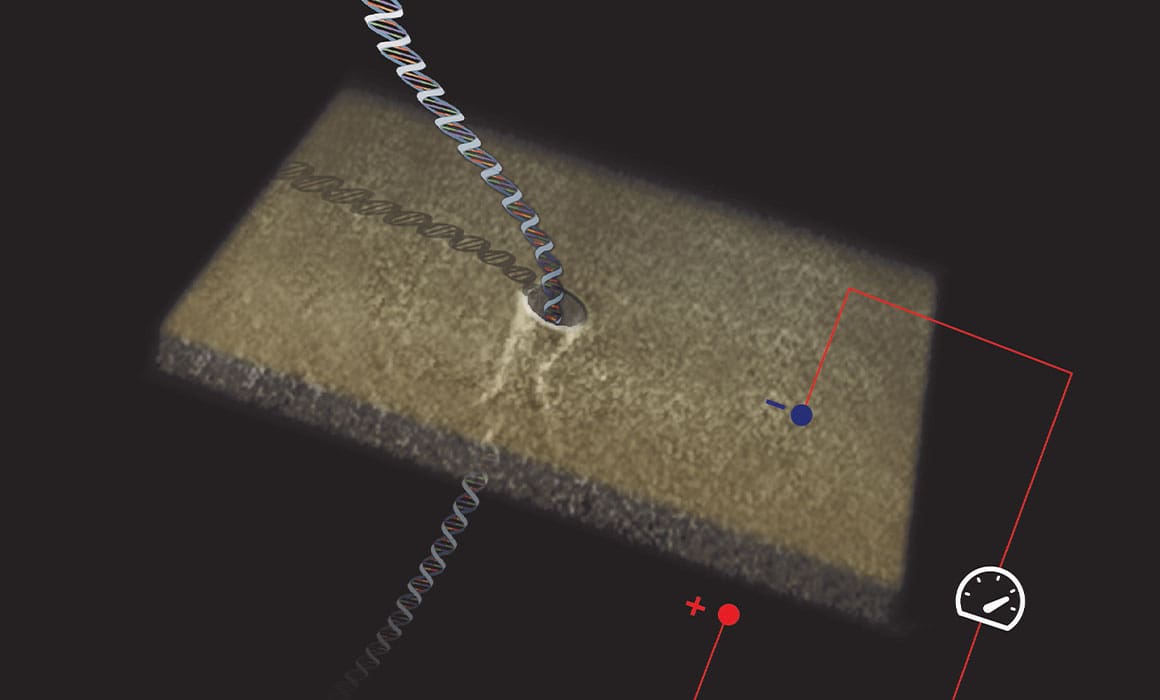
Featured Image: Illustration of DNA molecules passing through a nanopore one after the other
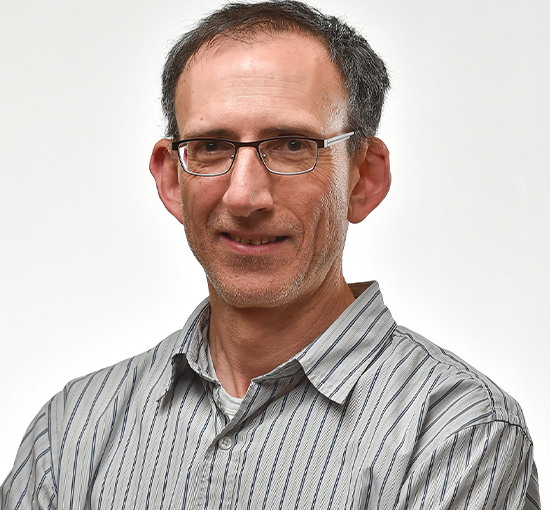
Amit Meller

Professor Amit Meller

Faculty of Biomedical Engineering

RT-qPRC Testing
The most widely used test for COVID-19 is the RT-qPCR test. It requires first collecting a sample from a patient using a swab, “opening” the virus, and extracting RNA from it. In the next stage, called reverse transcription (RT), specific ‘target’ RNA sequences are copied to the DNA form. Finally, this DNA is amplified by a polymerase chain reaction (PCR). Millions of copies are made so that enough DNA is present to be detected, finally leading to a diagnosis for COVID-19.

RT-qPCR testing requires large quantities of special reagents, expensive laboratory equipment, and highly trained professionals. Recent studies have also shown that test results can change from one day to the next and that the massive amplification process can generate significant errors. For these reasons, worldwide efforts are being devoted to developing faster, more affordable, and more accurate tests. This task is particularly challenging in cases where the “viral load” (the amount of viral RNA) in a sample is low and can evade sensing.

Using Nanopores to “Sense” COVID-19 and Metastatic Cancer
The new method presented by Prof. Meller’s research group relies on original technologies that the lab has developed in the past two decades, using nanofabricated holes (so-called “nanopores”) to sense single biological molecules. The effectiveness of this technology has already been demonstrated in a number of other biomedical uses.

Unlike conventional molecular diagnostics, which require large volumes of samples containing millions of copies of the same molecule, nanopore sensing analyzes individual biological molecules from much smaller samples. A strong electrical field is used to unfold and thread individual DNA molecules through the nanoscopic hole containing electrical or optical sensors. Each molecule that passes through the hole gives a characteristic “signature,” which enables identification and immediate counting of the molecules. This approach opens up the possibility of miniaturizing the diagnostic systems while improving the accuracy and reliability of tests.

In an article recently published in ACS Nano, the researchers present two applications of their new method: identifying RNA molecules that signal the emergence of metastatic cancer and detecting coronavirus RNA.

In the first application, the researchers demonstrated the method’s potential for early detection of metastatic cancer by quantifying the levels of MACC1 — one of the primary genes known to signal the formation of a metastatic state. Thanks to its high degree of sensitivity, the new technique successfully quantified the gene’s expression in cancerous cells at the early stages of illness (known as stages I and II) — a challenge that PCR-based technologies failed to meet. Needless to say, the earlier these genetic biomarkers are discovered, the better the chances of successful treatment.

In the second application, the researchers detected the RNA molecules of the SARS-CoV-2 virus using the same approach. Unlike other tests, the new approach avoids introducing “noise” and errors into the system, obtaining a more precise and accurate analysis method.

Commercializing the Technology
With further work, the nanopore sensing system is expected to become a portable device that will make cumbersome lab equipment unnecessary. Technological and clinical research is continuing at the Technion Faculty of Biomedical Engineering, in collaboration with the BioBank at the Rambam Health Care Campus. At the same time, steps are being taken to commercialize the technology in order to make it available for general use as soon as possible.

Related Stories

disease detection
Article

A Breathalyzer Test for Cancer?

September 17, 2026

What if diagnosing cancer, Parkinson’s disease, or other serious illnesses could be as simple as breathing into a handheld device? That possibility is moving closer to reality thanks to the work of the Technion’s Prof. Hossam Haick, whose groundbreaking research is changing how diseases are detected around the world. In recognition of his extraordinary achievements, […]

Go
artificial intelligence health care
Article

Europe Is Betting on Technion Innovation

September 04, 2026

Every year, the European Research Council (ERC) identifies some of the world’s most promising early-career researchers and gives them the freedom to pursue bold ideas. This year, two of those ideas came from the Technion – Israel Institute of Technology. From cancer research to artificial intelligence (AI), breakthroughs that shape the future often begin with […]

Go
Chatbot | American Technion Society | Donate to Israel
In The News

Can AI Chatbots Support Mental Health?

August 07, 2026

As more people turn to AI chatbots for companionship, life advice, or even as a stand-in for therapy, experts say the technology offers both new opportunities and risks when it comes to mental health. Prof. Tanzeem Choudhury is the chief of health innovation in the Joan & Irwin Jacobs Technion-Cornell Institute and has been studying AI and mental health for 15 years. She said AI tools are available any time, often at low cost, making it easier for people to access some form of mental health support.

Go

Love Israel and Science? 

Stay on top of the latest breaking scientific discoveries from Israel and the Technion. Subscribe to the ATS newsletter.

Secret Link