The Technion’s story has been intertwined with Israel’s for more than a century, from laying the foundations for a new nation to shaping its future.
From medicine to security, explore how the Technion is advancing Israel and improving lives around the world.
View All Impact Areas
Explore stories, news, insights, and data across articles, videos, and podcasts.
view all content types
of the student body are women
students
of the student body are Arab Israeli
The Technion’s story has been intertwined with Israel’s for more than a century, from laying the foundations for a new nation to shaping its future.
Explore ATS, the Technion, and the people behind the breakthroughs redefining what's possible for Israel and the world.
Learn More About ATSATS is a community of supporters, innovators, and champions of possibility united by one mission: transforming Israel and the world through science and discovery.
Learn MoreFor more than 100 years, the Technion has been Israel's technological engine and leading driver of innovation, technology, and entrepreneurship, transforming ideas into impact.
Learn More
Step inside Israeli innovation at the David and Janet Polak Visitors Center. Experience our 360° immersive movie and tech exhibition. Open to individuals and groups.
Learn MoreFrom medicine to security, explore how the Technion is advancing Israel and improving lives around the world.
View All Impact AreasExplore stories, news, insights, and data across articles, videos, and podcasts.
view all content typesDiscover ways to support, connect, and help drive innovation.
Get InvolvedExplore ATS, the Technion, and the people behind the breakthroughs redefining what's possible for Israel and the world.
Learn More About ATS
What if the treatment for your cancer was as unique as you are?
That’s the promise of a new technology developed at the Technion by doctoral students Gil Shamai and Ron Slossberg and Professor Ron Kimmel of the Technion Faculty of Computer Science, in collaboration with Dr. Yoav Binenbaum of Ichilov Hospital and Professor Ziv Gil of Rambam Medical Center.
The deep learning–based method for mapping critical receptors on cancer cells is expected to lead to better, more personalized cancer treatment.
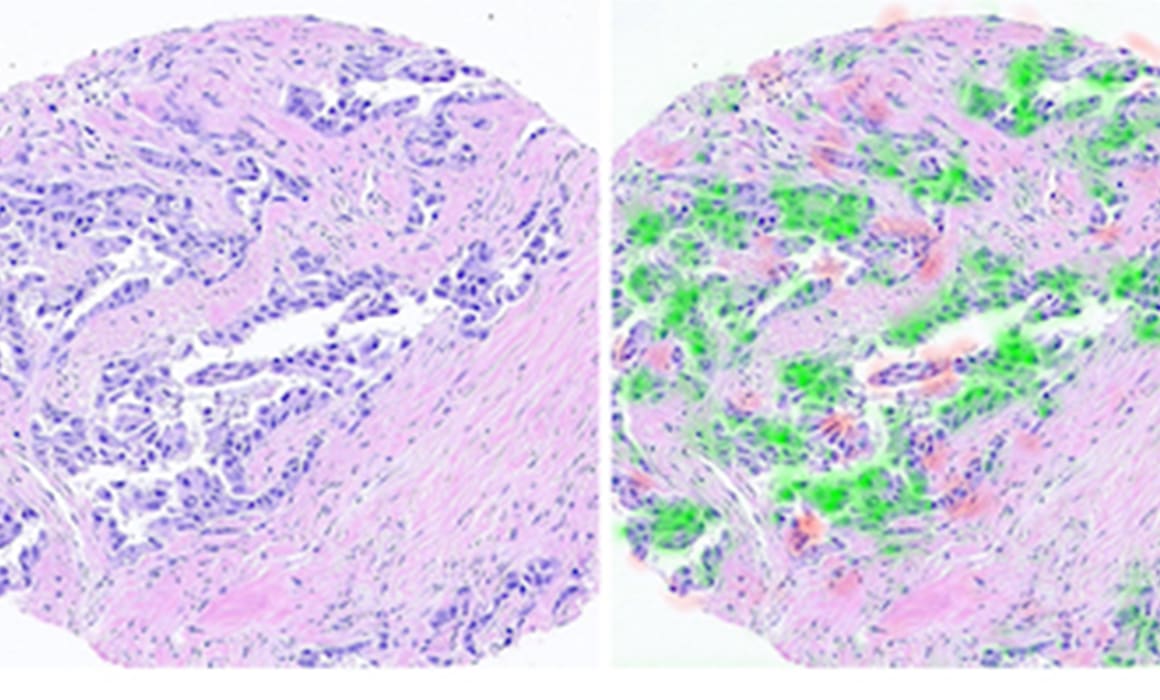
The technology extracts molecular information from digital biopsy images that underwent hematoxylin and eosin (H&E) staining. H&E staining allows the pathologist to identify the type of cancer and its severity in the tissue under the microscope.
But staining can’t tell us everything. Understanding the molecular profile of the tumor, its biological pathways, the genetic code of the cancer cells, and the common receptors on the cell membrane are essential in developing the right treatment for a patient.
Using Deep Learning in Cancer Care
So the Technion researchers found a better way, extracting molecular information from the cell shape and the environment (known as the morphology of the tissue) as reflected in the H&E scans.
With so many variables in a tumor’s shape, many pathologists assumed it was impossible to determine a tumor’s features based on shape. But by using deep learning and other artificial technologies, the Technion researchers are able to characterize the cancer with a complex analysis of its morphology…by simply looking at the tissue as it appears on a standard H&E scan.
It’s not easy to build a deep-learning system. The computer needs a huge amount of information to analyze and identify patterns. The Technion researchers accelerated the innovation process by writing a software code to scan network sources and automatically download thousands of biopsy samples and the relevant medical information approved for research.
Prof. Kimmel and the team examined more than 20,000 scans from 5,356 breast cancer patients. Using the new technology, they were able to map estrogen and progesterone receptors, among other molecular biomarkers, from the scans alone and based on cell morphology.
A Promising New Tool
While the team’s research focused on breast cancer, it is clear this technology could be used for all cancers: first as a decision-making tool to aid doctors, and later as a clinical tool for diagnostic purposes.
September 12, 2019
Understand the importance of pathologists in cancer care and how technology changes the landscape of personalized treatment.
1 min
X (opens in a new tab) / Facebook (opens in a new tab) / LinkedIn (opens in a new tab) / Email / Copy Link
AI / Breast Cancer /
What if diagnosing cancer, Parkinson’s disease, or other serious illnesses could be as simple as breathing into a handheld device? That possibility is moving closer to reality thanks to the work of the Technion’s Prof. Hossam Haick, whose groundbreaking research is changing how diseases are detected around the world. In recognition of his extraordinary achievements, […]
Every year, the European Research Council (ERC) identifies some of the world’s most promising early-career researchers and gives them the freedom to pursue bold ideas. This year, two of those ideas came from the Technion – Israel Institute of Technology. From cancer research to artificial intelligence (AI), breakthroughs that shape the future often begin with […]
As more people turn to AI chatbots for companionship, life advice, or even as a stand-in for therapy, experts say the technology offers both new opportunities and risks when it comes to mental health. Prof. Tanzeem Choudhury is the chief of health innovation in the Joan & Irwin Jacobs Technion-Cornell Institute and has been studying AI and mental health for 15 years. She said AI tools are available any time, often at low cost, making it easier for people to access some form of mental health support.
Stay on top of the latest breaking scientific discoveries from Israel and the Technion. Subscribe to the ATS newsletter.