Something Fresh in the State of Denmark
October 06, 2026
























The Technion’s story has been intertwined with Israel’s for more than a century, from laying the foundations for a new nation to shaping its future.

Step inside Israeli innovation at the David and Janet Polak Visitors Center. Experience our 360° immersive movie and tech exhibition. Open to individuals and groups.
Learn More

An Israeli food-tech company, Imagindairy, received approval from the Health Ministry to market its products throughout the country, the company recently announced. Imagindairy, founded in 2020 and headquartered in Haifa, produces sustainable, animal-free dairy proteins that are identical in taste, texture, and nutritional value to cow milk proteins, the statement said. The decision in Israel follows that of the Food and Drug Administration’s approval in the US about one year ago. Dr. Eyal Afergan, the CEO of Imagindairy and a graduate of Israel’s Technion Institute of Technology, said the approval is a significant milestone for the company, and demonstrates the…

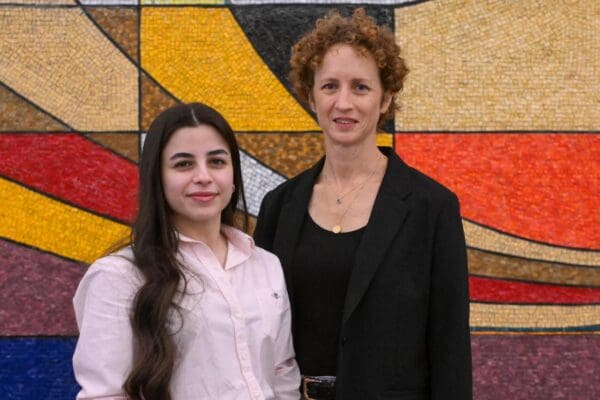
Researchers at the Technion Faculty of Biology have identified potential new innovative genetic therapies for cancer and brain diseases. The findings were supported by the Israel Science Foundation (ISF), the US-Israel Binational Science Foundation (BSF), NSF-BSF Molecular and Cellular Biosciences, and the National Institutes of Health (NIH) and were published in the peer-reviewed journal Nucleic Acids Research. The study was conducted in collaboration with the research group of Professor Heather Hundley from Indiana University and was led by Ph.D student Berta Eliad, master’s student Noa Schneider, and their advisor, Associate Professor Ayelet Lamn.

This 3D-printed postmastectomy bra could be the next best breast prosthesis. Here’s how the technology works. Tal was diagnosed with stage 3 breast cancer in the fall of 2019. She underwent chemotherapy, a mastectomy, and whole breast radiation. Tal wasn’t a candidate for reconstructive surgery, because radiation thinned her skin and reduced its elasticity. Determined to move on and regain confidence, she tried her first breast prosthesis at a hospital. “It was knitted and looked like a pillow,” she says. “It made me laugh because it looked nothing like a real breast.” U·Bra was co-developed by Technion Professor Yoav Sterman.

On Tuesday, November 5, 2024, the Technion inaugurated the Uzia Galil Foyer in the Andrew and Erna Viterbi Faculty of Electrical and Computer Engineering. The foyer was named after the founder of Elbit Systems and other companies. The ceremony was attended by Galil’s family and Elbit Systems management including president and CEO Bezhalel (Butsi) Machlis and former Elbit Systems Board Chairman Miki Federman. Technion President Prof. Uri Sivan, Dean of the Viterbi Faculty of Electrical and Computer Engineering Prof. Idit Keidar, and Chairman of the Israel Friends of Technion Association, Prof. Peretz Lavie, were also in attendance. The foyer, which…

Technion researchers have developed a software package that enables computers to perform processing operations directly in memory, bypassing the CPU. This is a significant step toward developing computers that perform calculations in memory, avoiding time-consuming and energy-intensive data transfers between hardware components. A new and exciting field has emerged in the hardware domain in recent years: in-memory computing. The in-memory computing approach introduces a significant change from the way computers typically operate. While traditionally the CPU runs calculations based on information stored in the computer’s memory, with this innovative approach, some operations are performed directly within the memory, reducing data…

An experimental setup built at the Technion Faculty of Physics demonstrates the transfer of atoms from one place to another through quantum tunneling between optical tweezers. Led by Prof. Yoav Sagi and doctoral student Yanay Florshaim from the Solid State Institute, the research was published in Science Advances. The experiment is based on optical tweezers—an experimental tool for capturing atoms, molecules, and even living cells using an optical potential created by laser beams focused on a micron-sized spot. How is this possible? The interaction of light with matter generates a force proportional to the intensity of the light. This force…

New Report Quantifies Cornell Tech’s Role in Attracting Talent to New York City and Growing the City’s Tech Sector Since its founding in 2012, Cornell Tech has played a crucial role in developing New York City’s tech talent, entrepreneurship, job creation, and fiscal prosperity. From launching more than 100 startups and educating thousands of new tech leaders to operating an 850,000-square-foot campus while planning future expansion, the energy coming out of the regional tech hub is undeniable. But what is its overall economic impact? A new analysis from economic development firm HR&A puts it into numbers – and they are…

LifeCord has a strong intellectual property (IP) portfolio, including 52 patent families pending worldwide and 21 issued or allowed patents. This IP position ensures market exclusivity and gives LifeCord a significant competitive edge. You can learn more about the company below. LifeCord is pioneering innovative solutions for mitral chordal repair, addressing mitral regurgitation, which affects approximately 2% of the global population. Our flagship product is a breakthrough leaflet-preserving device that avoids puncturing the leaflet and enables future interventions, aiming to disrupt the market with a safer, superior, and primary solution for degenerative mitral regurgitation (DMR) patients. The device offers a…

AI video generators can’t understand the laws of physics solely by watching videos, scientists have found. Coming hot on the heels of chatbots and image generators, AI video generators like Sora and Runway have already been delivering impressive results. But a team of scientists from Bytedance Research, Tsinghua University, and Technion were curious to learn if such models could discover physical laws from visual data without any additional human input. While in the real world, we understand physics through math, in the world of video generation, an AI model that understands physics should be able to watch a sequence of…

Two AI-based startups in Israel are joining forces to combat the pests and diseases that destroy up to 40 percent of all food grown globally. Fermata uses cameras and artificial intelligence to monitor crops as they grow and automatically detect problems. yieldsApp translates that data into tailored recommendations, crop by crop, field by field, to maximize yields for the grower. The two companies have now announced a partnership that will merge their technologies and, they say, provide a “comprehensive farm management solution,” detecting problems and providing precise solutions. Farmers will receive “personalized, real-time insights that ensure crops get the right…

Dry conditions in the Northeast are worsening, creating a scenario for fire danger in the region to persist, an updated map from the U.S. Drought Monitor shows. The worst of the drought conditions are located in a large swath of West Virginia, several counties in South New Jersey and three counties in southwest Pennsylvania — all of which are in extreme drought, according to the Drought Monitor. Most of Massachusetts, New York, New Jersey and West Virginia are in severe drought, the map shows. The drought situation the Northeast is currently facing was strongly propelled by the lack of precipitation…

The ability to walk independently in nature, in a shopping mall, or in any unfamiliar space isn’t a given for people with vision impairment. Award-winning Israeli company RightHear is changing that reality, one venue at a time. Tens of thousands of people are finding their way to and around more than 2,500 locations that have installed the audio orientation and guiding system so far. These include restaurants, supermarkets, hotels, healthcare facilities, theaters, malls, airports and college campuses in Israel, North America, the United Arab Emirates, Lithuania, Greece and Angola. In August, Natural Bridge State Park in Virginia became the first…