Something Fresh in the State of Denmark
October 06, 2026






























The Technion’s story has been intertwined with Israel’s for more than a century, from laying the foundations for a new nation to shaping its future.

Step inside Israeli innovation at the David and Janet Polak Visitors Center. Experience our 360° immersive movie and tech exhibition. Open to individuals and groups.
Learn More
New Technion-Rambam center will bring physicians, scientists, and engineers together to accelerate medical innovation
Some of the most important questions in medicine begin at a patient’s bedside. Answering them can require far more than medicine alone.
That is the idea behind the Andrea and Lawrence Wolfe Center for Translational Medicine and Engineering, a new joint initiative of the Technion and Rambam Health Care Campus designed to bring physicians, scientists, and engineers together to accelerate the development of treatments and medical technologies.
Made possible by a generous donation from Andrea and Lawrence Wolfe, the Center will be located on two floors of the Helmsley Health Discovery Tower at Rambam. Its advanced research laboratories will encompass artificial intelligence and medicine, biochips, drug delivery and molecular therapies, medical devices, tissue engineering and regenerative medicine, and healthcare systems operations.
Bringing these diverse fields together under one roof is intended to shorten the journey from discovery to application, creating an environment where medical needs can spark new research and promising innovations can move more quickly toward the patients who need them.
“The combination of a research hospital and a technological university provides the entire value chain, from the patient’s bedside to the research and development laboratories and back to the patient’s bedside,” said Technion President Prof. Uri Sivan.
The partnership is rooted in a simple idea: Medicine advances when different disciplines meet.
Rambam Health Care Campus Director General Dr. Michal Mekel pointed to Kurt Semm, the father of modern laparoscopy, as an example. Both a physician and an ingenious toolmaker, Semm helped revolutionize surgery by enabling many procedures to be performed in a minimally invasive manner.
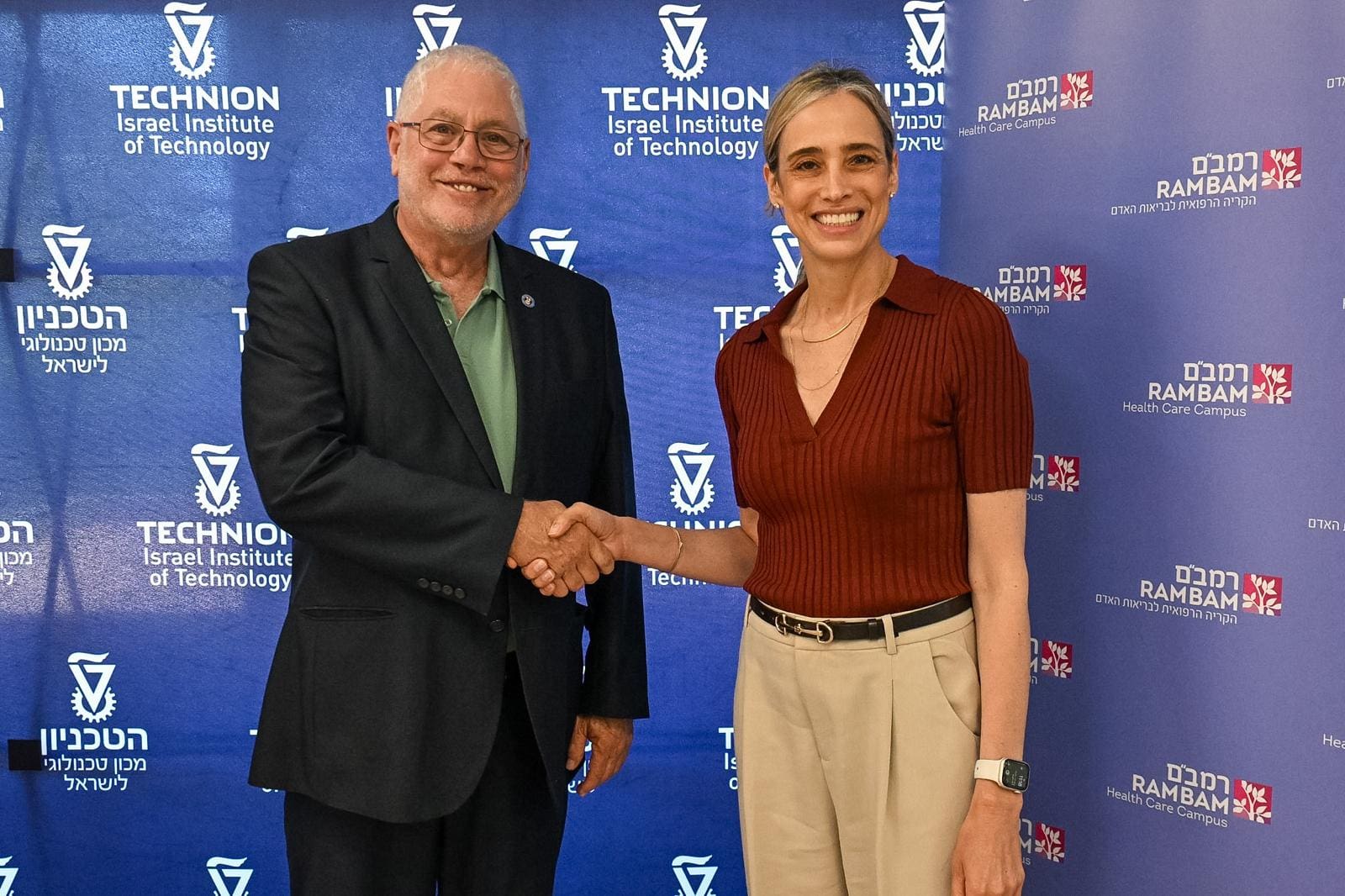
“Today, as researchers and physicians, it is clear to us that medicine cannot exist and advance without research, not only research in the life sciences, but also in engineering,” said Mekel. “Breakthroughs emerge when different worlds meet, and in our case, when medicine meets engineering.”
That intersection is already taking shape in collaborations between Technion and Rambam researchers.
Prof. Noam Ziv, the Technion’s deputy senior executive vice president for engineering, life sciences and medicine, pointed to a recent competition for a joint research grant focused on Implementing Artificial Intelligence Models in the Hospital of the Future. The winning team brought together a Technion researcher from the Faculty of Architecture and Town Planning, a researcher from the Faculty of Data and Decision Sciences, the director of Rambam’s Ambulatory Services Division, and a senior member of Rambam’s administration.
For Prof. Lior Gepstein, director of the Research Division at Rambam and a faculty member in the Technion’s Ruth and Bruce Rappaport Faculty of Medicine, that kind of collaboration is essential because the challenges of medicine do not fit neatly within individual disciplines.
“To find new solutions, we must bring together medical teams with firsthand knowledge of patients’ needs, scientists who investigate the mechanisms of life, and engineers who know how to transform an idea into a practical solution,” he said.
The Center’s location at Rambam is intended to help make that exchange possible in both directions. Questions arising at a patient’s bedside can become research projects, while research achievements can be translated into new medical treatments.
The agreement also strengthens a longstanding relationship between the Technion and Rambam, building on a vision that former Rambam Director General Prof. Rafi Beyar began advancing some 20 years ago.
For Andrea and Lawrence Wolfe, whose philanthropy made the new Center possible, that vision means connecting institutions and disciplines around a common purpose.
As President Sivan said, the Wolfes “have not only contributed generously but have embraced the vision at the heart of this collaboration, the aspiration to solve major problems facing humanity by combining science, medicine, and engineering.”
The agreement establishing the Center is only the beginning. Its ultimate ambition is not simply to generate research, papers, or patents, but to build a community capable of turning medical needs into practical solutions and bringing those solutions to patients. As Prof. Gepstein put it, “the agreement we are signing today is not the finish line, but the starting point.”