Why the Perfect Pitch is Your Biggest Mistake
September 23, 2026


























The Technion’s story has been intertwined with Israel’s for more than a century, from laying the foundations for a new nation to shaping its future.
Step inside Israeli innovation at the David and Janet Polak Visitors Center. Experience our 360° immersive movie and tech exhibition. Open to individuals and groups.
Learn More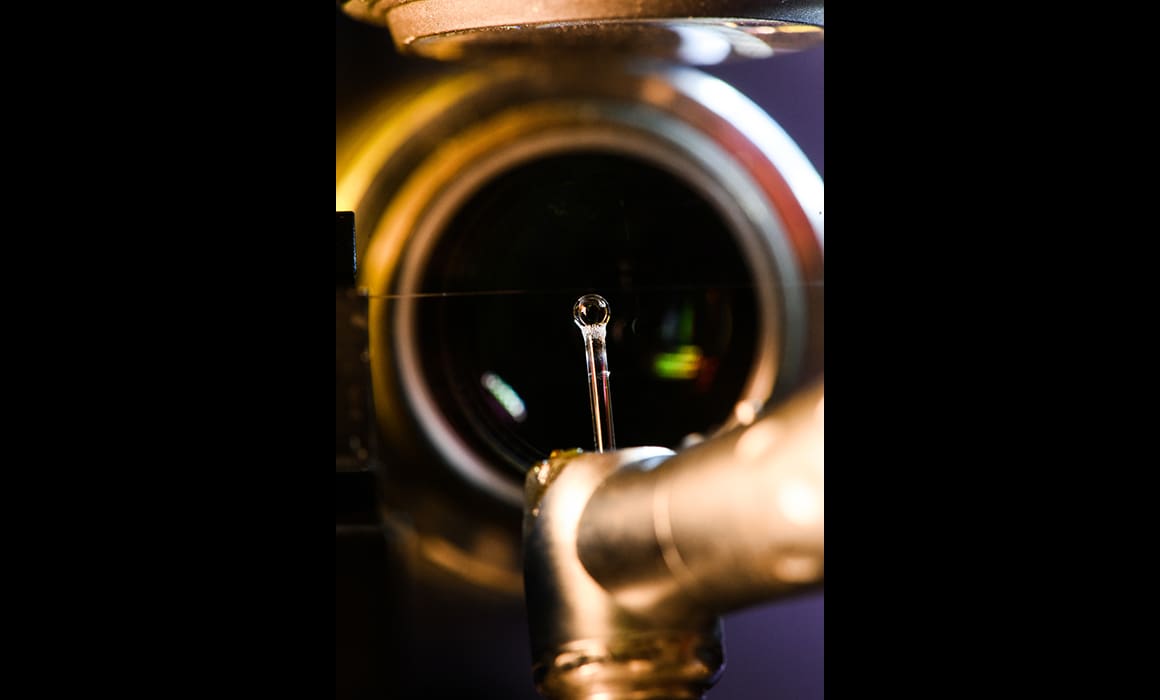
Technion researchers have constructed a first-of-its-kind optic isolator: the first photonic device in which light advancing in opposite directions moves at different speeds. The isolator can isolate 99.6% of light — a requirement for quantum optics communication devices, high-powered lasers, and other applications.
The new isolator is unique because it works well when light from both opposing directions is simultaneously perceived. It is also compatible with standard optical-fiber technology, can be scaled down, and does not change the color of the light.
The isolator was developed by Professor Tal Carmon of the Faculty of Mechanical Engineering and his team and collaborators at the College of Optics and Photonics (CEOL) at the University of Michigan and Hunan Normal University. The experiment at the Technion was conducted by Rafi Dahan, who was a master’s student at the time, and Shai Maayani, then a doctoral candidate.
The Speed of Light
Riding a bicycle with the wind behind you is easier than riding against the wind. Light is no different. It changes its speed with “tailwinds” or “counter-flow” in response to the medium in which it’s moving. The speed of light in glass, for instance, is slower than its speed in air.
And just like riding a bicycle in the wind, the speed of light against the movement of the medium is slower than its speed with the movement of the medium. This is what’s known as the Fresnel-Fizeau drag, first described in 1849 by French scientist Armond Fizeau.
It’s long been suspected that the Fresnel-Fizeau drag could lead to significant applications in optics and computers, as its unique ability to differentiate between the speeds of light for counter-propagating beams can generate an optic isolator. But until the Technion researchers’ breakthrough, such a device had not been constructed.
A Novel Optic Isolator
The new isolator is a spherical optic device that rotates at a high speed. Light beams enter the isolator from both ends of a standard optical fiber that is 100 times smaller than the diameter of a human hair. The sphere of the device rotates at ultra-fast speeds of up to 300 kph.
The light approaching from the right moves along the circumference of the ball, in the direction of the rotation of the sphere. The light approaching from the left turns opposite of the rotation, moving at a slower speed.
The light entering from the right is moving so fast that it echoes inside the sphere while circulating thousands of times in the sphere, until it is absorbed. In contrast, the slower-moving light entering from the left passes through the device practically undisturbed.
One of the engineering challenges the team faced was keeping the ultra-short distance between the fiber and the resonator — a sphere moving at 300 kph — constant. This was especially difficult when the sphere is rotating at such high speeds. The researchers were able to design the fiber to float on the wind generated by the rotation of the sphere, preserving the distance between fiber and sphere.
Prof. Carmon hopes this novel design is the first step toward a new type of mechanical device based on relatively unexplored forces originating from quantum effects, such as Casimir and van der Waals forces. Up until now, these forces have barely been exploited in mechanical devices.