Something Fresh in the State of Denmark
October 06, 2026

































The Technion’s story has been intertwined with Israel’s for more than a century, from laying the foundations for a new nation to shaping its future.

Step inside Israeli innovation at the David and Janet Polak Visitors Center. Experience our 360° immersive movie and tech exhibition. Open to individuals and groups.
Learn More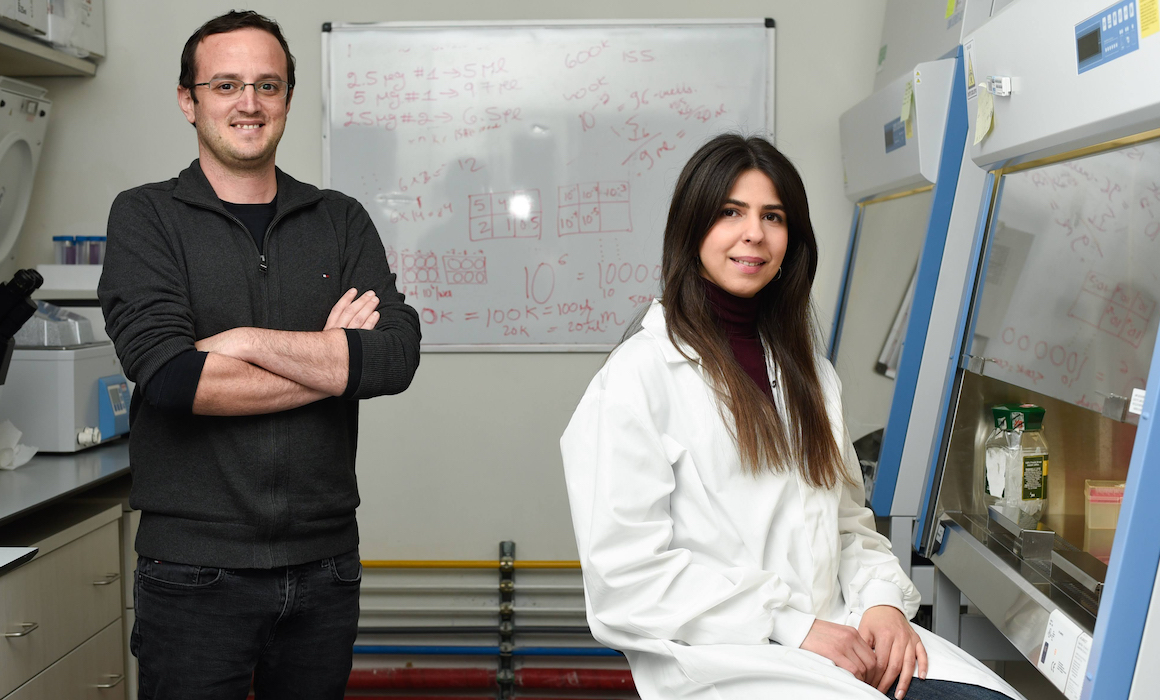
Pictured Above / Prof. Yotam Bar-On (left) and Dina Khateeb / Photo credit: Rami Shelush, Technion Spokesperson’s Office.
Although the original form of the novel coronavirus — SARS-CoV-2 — was armed with an effective system against mutations, it was not immune to them. Indeed, the virus has since “split” into variants according to differing evolutionary variables in different populations. These mutations occur in the spike protein of the virus, which allows it to penetrate the cells in our body.
The development of new variants is the result of random mutations and natural selection. Most mutations do not significantly alter the virus’s ability to survive and infect, but some give it a significant advantage to thrive and spread in the community.
Many research groups are currently studying the mechanism for the development of new coronavirus variants, through analyzing their evolution and specifically the evolution of the spike protein. This has allowed for the unprecedented development of dedicated, effective mRNA vaccines that have largely curbed the pandemic.
Much of this research has focused on how variants are formed in the population. But a new study carried out at the Technion and published in PLOS Pathogens sheds light on a lesser-studied area: new variants at the individual level, or, in other words, what happens in the body of the patient during their illness. The study was led by Assistant Professor Yotam Bar-On and doctoral student Dina Khateeb, both of the Rappaport Faculty of Medicine.
Individual-Level Variants
The study is the culmination of a year and a half of work and is based on an experimental platform that Prof. Bar-On began developing during his postdoc. The technology, initially developed as part of HIV research, sequences the genome of the virus on an individual level and compares different variants that have developed in a patient’s respiratory system. Furthermore, it can detect very low doses of the virus found in tissue cells that do not show up with simpler methods.
During the study, the researchers discovered various mutations not included in existing databases and even a new, previously unknown variant. The researchers also examined the efficacy of existing vaccines against these variants and found that the efficacy varies depending on the different types of mutations in the spike protein.
The good news is that the mutations that develop in the patient’s body generally produce variants that are not able to be transmitted from person to person. The researchers emphasize that further research must still be conducted, but these findings hold true for the 10 variants examined to date in the study.
Using the Body to Battle Coronavirus
The researchers identified a specific mutation in s2, one of the spike proteins, which impairs the effectiveness of antibodies battling the virus. “This identification is an important factor in understanding the adaptation of the virus to its host’s body,” explains Prof. Bar-On. “We appreciate that our findings may lead to the detection of weaknesses of the virus — mechanisms that weaken its ability to infect — and to develop new measures to curb infection.”
The findings show that analysis of the evolution of the virus at an individual level contributes to a better understanding of its development and of possible ways to combat it using vaccines and drugs. The researchers, who have focused on mutations related to the Alpha variant, estimate that a similar analysis of the Delta variant — currently the most dangerous strain — may increase the toolbox available to science and medicine in the fight against the pandemic.