Something Fresh in the State of Denmark
October 06, 2026






















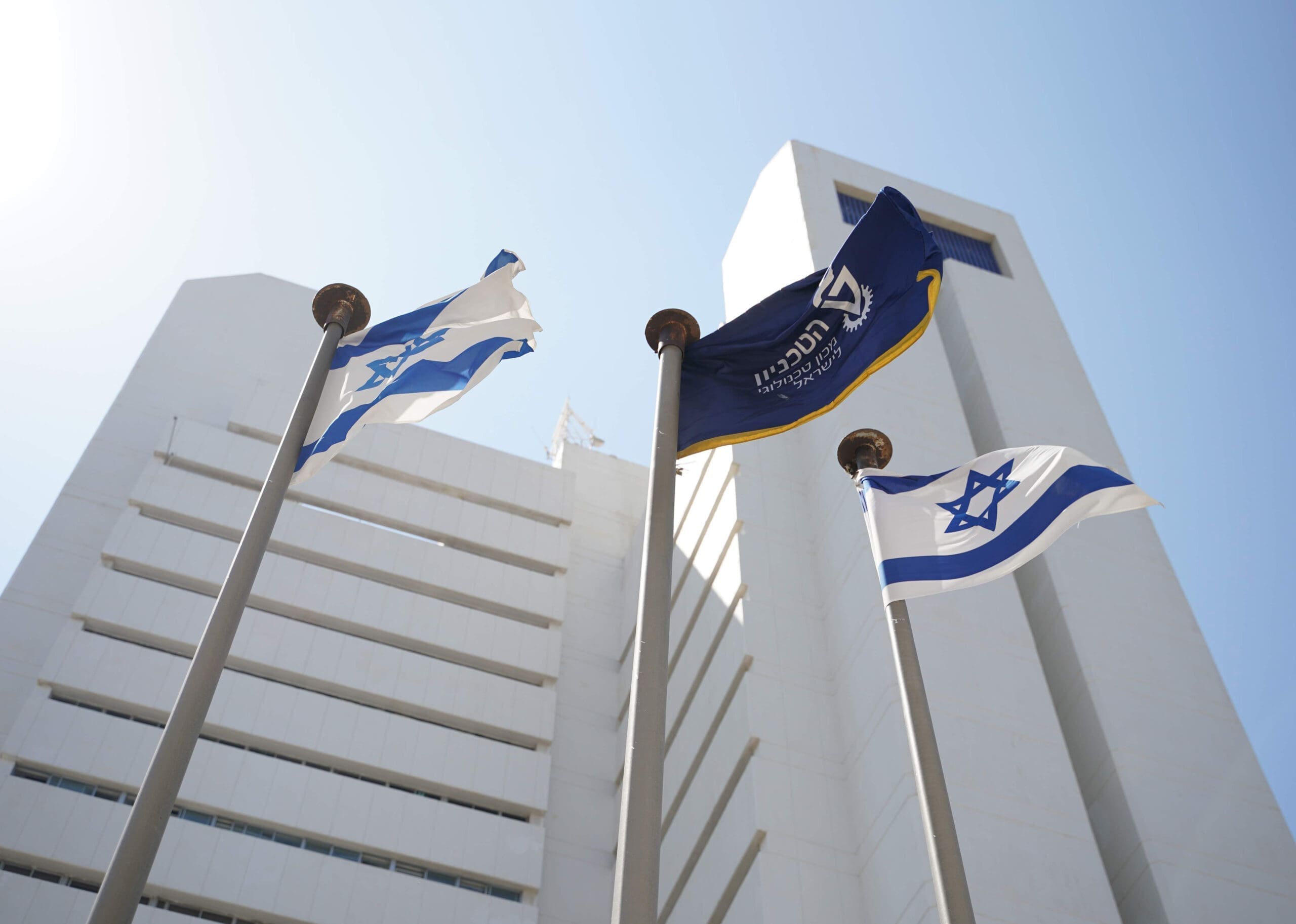






The Technion’s story has been intertwined with Israel’s for more than a century, from laying the foundations for a new nation to shaping its future.

Step inside Israeli innovation at the David and Janet Polak Visitors Center. Experience our 360° immersive movie and tech exhibition. Open to individuals and groups.
Learn MoreAssistant Professor Yonatan Savir ’04 heads a lab in the Technion’s Rappaport Faculty of Medicine that studies information processing in biological systems and its failure in aged cells. His interdisciplinary research has led to unique algorithms that extract precise data from inexpensive thermal imaging cameras — technology that was used in his COVID-19 device. He […]
Prof. Jackie Schiller’s work in the Rappaport Faculty of Medicine and the Allen and Jewel Prince Center for Neurodegenerative Disorders of the Brain seeks to understand the brain’s largest and most complex structure, the cerebral cortex, and its links to Parkinson’s disease, epilepsy, autism, and more. The cerebral cortex is responsible for our most basic sensory and motor functions as well as the higher functions of learning, memory, and emotions. Researchers in the Cortical Computation Lab bearing her name focus on how information is processed, changed, and stored in the neurons of the brain’s cortex. Conducting experiments in learning and…
Prof. Shima’s research interests focus on the guidance of vehicles, mainly aerial, operating individually or as a team. The interdisciplinary work of CASY scientists spans from cooperatively planning and guiding spacecraft with regard to optimizing and following their trajectories, and low-level control of a single vehicle. Their work seeks to devise new algorithms and strategies for performing both cooperative and individual tasks. Prof. Shima received all three degrees from the Technion, earning his Ph.D. in 2001, and an MBA from Tel Aviv University. He joined the Technion in 2006 and founded the CASY lab. From 2020 to 2023, he was…
Prof. Raveh focuses her work in the area of aeroelasticity, the interaction between aerodynamic forces and flexible structures. In an attempt for green aviation, new aircraft designs are lighter and more flexible, and thus experience aeroelastic phenomena that must be controlled. To that end, she and her students built a 3D-printed unmanned aerial vehicle (UAV) that will serve as a platform for aeroelastic experimentation. Their A3TB, Active Aeroelastic Aircraft Testbed, will help reach the goal of designing aircraft that are lightweight and have a large wingspan, reducing drag forces to cut energy consumption and pollution. Its maiden May 2020 test…
Prof. Shaked’s lab pioneered the term “host response to anti-cancer drugs”— a patient’s response to cancer treatments, which may explain therapy resistance and cancer metastasis. He found that anti-cancer drugs, including chemotherapy, radiation, surgery, targeted drugs, and even immunotherapy, can contribute to cancer cell resistance or spread by provoking the body to protect its cancer cells from the toxic effects of treatments. This research has paved the way for new combinations of cancer treatments that block the body’s protective patterns, increase therapeutic outcome, and further support precision medicine in oncology. Prof. Shaked founded the company OncoHost, a next-generation leader in…
One of Israel’s rising stars in the areas of chemical and biomedical engineering and nanotherapeutics, he has received more than 15 national and international excellence awards. His research group in Wolfson Faculty of Chemical Engineering develops biomimetic nanoparticles to treat neurodegenerative pediatric diseases, brain injuries, and multiple cancers. He has developed various novel drug delivery systems, each aiming to deliver different treatments and target different diseases. One such system, dubbed “nano-taxis,” are tiny, nature-mimicking vesicles that carry medication such as mRNA directly to targeted neurons, without being destroyed or changed en route, to potentially revolutionize various treatments and drug delivery….
Professor Eyal Zussman made media headlines recently as the inventor of the “Maya” sticker, one of the Technion’s earliest and most successful developments in the fight against COVID-19. The unique sticker consists of nanofibers coated with antiseptics to trap and kill the coronavirus on the spot. The sticker, made by a 3D printer, was adopted by the COVID-19 National Emergency Team of Israel’s Defense Ministry, developed in conjunction with the Galilee Medical Center in Nahariya, and is currently in production at the Dykam paper plant on Kibbutz Ein Harod. As of mid-August, Dykam was manufacturing 5,000 stickers per day and…
Soil and water contamination, caused by industrial activity, agricultural practices, and improper waste disposal, can lead to a variety of environmental and health problems. Prof. Radian’s team in the Soil and Environmental Chemistry Lab designs advanced material based on natural particles such as clays, that can absorb and degrade pollutants in natural and engineered systems. She recently developed an efficient technology for cleansing drinking water of perfluoroalkyl and polyfluoroalkyl substances (PFAS), which have been linked to various health risks. Previously, she collaborated with Biotechnology and Food Engineering Professor Ayelet Fishman to develop and patent technology to purify industrial wastewater from…
Prof. Shpigelman’s research focuses on the interplay between food processing, the structure of food components, and their behavior during shelf life and at the end of their bioactivity in our body. He is guided by the principle that the design of food processing should carefully balance aspects that are important to consumers’ health and well-being. Currently, he is experimenting with non-thermal food technologies such as high-pressure processing, which uses cold processing techniques rather than conventional heat to eliminate microorganisms and optimize nutrition. Prof. Shpigelman completed all his degrees at the Technion and conducted postdoctoral research at KU Leuven in Belgium,…
Professor Josué Sznitman heads the Technion Biofluids Laboratory in the Faculty of Biomedical Engineering and is also the director of the Norman Seiden Multidisciplinary Graduate Program in Nanoscience and Nanotechnology in the Russell Berrie Nanotechnology Institute. Prof. Sznitman is a world leader in the area of pulmonary physiology and drug delivery to the lungs. He engineered an inhaler that dispenses aerosol droplets of chemotherapy and magnetic nanoparticles to the lungs. A magnet outside the body directs the droplets to the tumor, while drugs outside the magnetic field are exhaled. In earlier research, he created a life-sized artificial lung to watch…
Prof. Rothschild leads the Electrochemical Materials & Devices research group. His research focuses on materials and devices for water splitting as a means of sustainably producing green hydrogen from renewable energies such as solar and wind. He is co-founder of H2Pro, a startup company that develops water splitting technology for the low-cost production of green hydrogen. Prof. Rothschild is one of the founding directors of the Israeli Center of Research Excellence on Solar Fuels and a member of several European consortia, and he holds a European Research Council grant for research on ultrathin-film solar cells. He is a fellow of…
Prof. Sivan is married to Yael, a father of three, and a grandfather of five who was born in Haifa, Israel. He earned a B.Sc. in Physics and Mathematics, an M.Sc. both (cum laude), and a Ph.D. in Physics (summa cum laude) from Tel Aviv University. In 1991, after three years at IBM T. J. Watson Research Center in Yorktown Heights, New York, Prof. Sivan joined the Faculty of Physics at the Technion where he currently holds the Bertoldo Badler Chair. His early scientific career focused on the physics of miniature electronic devices at low temperatures where quantum mechanics dominates…