

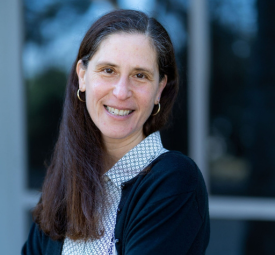
Organic semiconductors have uniquely beneficial properties: they are transparent, flexible, low-weight, low-cost, printable, and bio-compatible. Their applications, too, are vast, and they are already enhancing our lives every day: our mobile phone displays are illuminated using an organic semiconductor known as an OLED (organic light-emitting diode). Some modern televisions, likewise, rely on organic devices.
Gitti’s lab group, the Organic and Hybrid Materials and Devices Group, is pushing the field of Organic Electronics forward by working at the intersection of materials science, engineering, chemistry, and physics. By investigating how different processing techniques and material compositions affect device performance, the group aims to develop strategies that optimize the functionality of organic devices. It seeks to deepen our understanding of how molecular interactions and phase behavior influence device performance and stability. The group’s interdisciplinary approach is yielding creative solutions and making significant contributions to the fields of bioelectronics (e.g. artificial skin) and energy devices (e.g. solar cells).
Gitti received her bachelor’s degree from the Hebrew University of Jerusalem and her Ph.D. from the Weizmann Institute of Science.