The Technion’s story has been intertwined with Israel’s for more than a century, from laying the foundations for a new nation to shaping its future.

From medicine to security, explore how the Technion is advancing Israel and improving lives around the world.
View All Impact Areas
Explore stories, news, insights, and data across articles, videos, and podcasts.
view all content types
locations
of the student body are women
in Europe and #21 in the world for aerospace engineering*
The Technion’s story has been intertwined with Israel’s for more than a century, from laying the foundations for a new nation to shaping its future.
Explore ATS, the Technion, and the people behind the breakthroughs redefining what's possible for Israel and the world.
Learn More About ATSATS is a community of supporters, innovators, and champions of possibility united by one mission: transforming Israel and the world through science and discovery.
Learn MoreFor more than 100 years, the Technion has been Israel's technological engine and leading driver of innovation, technology, and entrepreneurship, transforming ideas into impact.
Learn More
Step inside Israeli innovation at the David and Janet Polak Visitors Center. Experience our 360° immersive movie and tech exhibition. Open to individuals and groups.
Learn MoreFrom medicine to security, explore how the Technion is advancing Israel and improving lives around the world.
View All Impact AreasExplore stories, news, insights, and data across articles, videos, and podcasts.
view all content typesExplore ATS, the Technion, and the people behind the breakthroughs redefining what's possible for Israel and the world.
Learn More About ATS
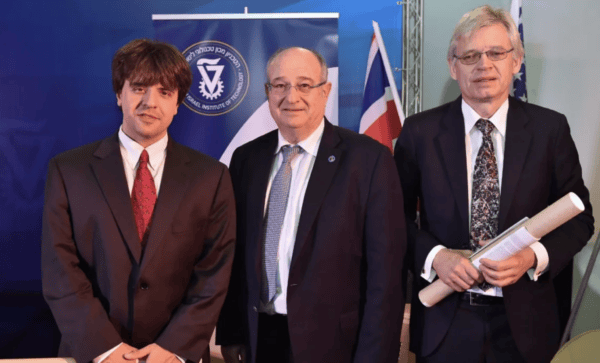
Dr. Ivry is a Faculty Scholar in the Zuckerman STEM Leadership Program (opens in a new tab) which supports future generations of leaders in science, technology, engineering, and math in the United States and Israel and, over time, fosters greater collaboration between the world’s most advanced scientific research centers.
His B.Sc. was from a program for excellent students at the Hebrew University. He received his M.Sc. from the Weizmann Institute of Science, and his Ph.D. from the University of Cambridge, UK (2004, 2006 and 2011, respectively). Then he spent 3 years at MIT as a post-doctoral scholar, finally returning to Israel at the Technion. He is an expert in nano-functional materials—specifically, the interplay between the insulating nature of ferroelectrics and superconductivity.
This is an extremely important issue, both fundamentally and technologically, that may provide an insight into the emergence of cooperative phenomena in electronic materials and, potentially, to the development of novel devices with advanced functionality, such as low-power computers. Recognized as someone who is “brimming with new ideas,” Ivry’s scientific activity has earned him prestigious prizes and awards including the Horev Fellowship, the British Council Chevening Award, the Klein Prize, and a Nokia Fellowship. He has delivered lectures at prestigious conferences and seminars in his research field and has published and reviewed papers for leading scientific journals.
To learn more about Yachin Ivry’s cutting-edge research, check out his in-depth Q&A here (opens in a new tab).
Before Israel became a state, the Technion was educating the people who would help build it. As the country grew, its challenges called for new knowledge — and generations of Technion minds answered. This short film follows that journey, from the engineers who helped construct Israel’s infrastructure to the researchers whose discoveries strengthened its security, […]
At the Technion, Israel Institute of Technology, the future often begins with a deceptively simple question: What can we do today that we could not do before? “Science and engineering have never been about yesterday’s tasks. They’ve always been about the future,” said Prof. Lihi Zelnik-Manor, vice president of External Relations and Resource Development at […]
Their study investigated fruit flies, a classic model organism in genetics. It focused on the species Drosophila sechellia, whose ancestors’ larval bodies possessed tiny hair-like structures (trichomes). These structures have disappeared over the course of evolution. In other words, the same evolutionary outcome — the loss of gene expression — emerged through several distinct molecular […]
Stay on top of the latest breaking scientific discoveries from Israel and the Technion. Subscribe to the ATS newsletter.