Something Fresh in the State of Denmark
October 06, 2026


























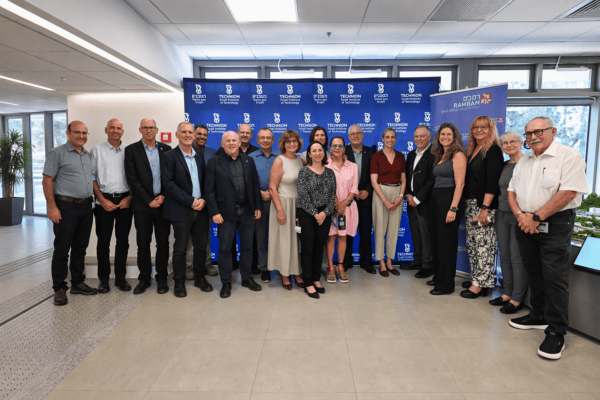



The Technion’s story has been intertwined with Israel’s for more than a century, from laying the foundations for a new nation to shaping its future.

Step inside Israeli innovation at the David and Janet Polak Visitors Center. Experience our 360° immersive movie and tech exhibition. Open to individuals and groups.
Learn More

A hunch by a respected Israeli biochemist about a molecule found in papaya has opened the door to revolutionize the treatment for metabolic and respiratory disorders, including cystic fibrosis (CF) in children. Inspired by the hunch, Israeli biotech startup ODE Pharma was founded with the mission of developing safe and cost-effective treatments for children suffering from the genetic disease. CF is caused by a defective gene that makes the body produce thick and sticky mucus in the lungs and other organs, which leads to a variety of serious lifelong issues, including chronic respiratory problems and recurrent lung infections. There is…

On Friday evening, Boeing Co.’s Starliner capsule will undock from the International Space Station, marking another chapter in the saga of the troubled spacecraft. Starliner will return to Earth uncrewed, with Butch Wilmore and Suni Williams — the NASA astronauts it transported to the orbiting space lab in June — forced to wait for a ride home with their rival SpaceX in early 2025. NASA’s decision to choose SpaceX to bring the astronauts home amid Starliner’s problems was a blow to Boeing. So what’s next for the Starliner program? Technion Professor Ehud Behar is quoted in this article.

Israeli company DeepDense, which specializes in AI medical imaging, has teamed up with US firm Spectrum Dynamics Medical, a leading innovator in digital imaging, to develop innovative applications for analysis of cardiac and spine diseases. By working together, the two companies aim to use DeepDense’s advanced AI technology to improve diagnostic accuracy, streamline workflows, and improve patient care. The DeepDense AI applications will be added to Spectrum Dynamics’ portfolio of solutions, along with the former’s unique 3D labeling tools. “The integration state of the art digital SPECT technology with advanced AI features will open the path to new capabilities in…

A new Israeli study has determined that processed food is not bad for us – despite its long-standing poor reputation – and with the right addition of proteins can actually give our bodies a boost. Processed food is actually a blanket description for any foods that have been changed in some way during their preparation. This could be drying, preserving (which is what we usually think of when we hear the term) or even cooking itself. And while we imagine processed foods to be ones that have undergone a more drastic treatment like breakfast cereal, ready meals, canned meat or…

The oldest and leading Arab-owned med-tech company in Israel started in a city in the Israeli periphery known more as Jesus’s hometown than a high-tech hub. But for Reem Younis, 59, who grew up in a working-class Christian family in Nazareth, there was no better location to found what has become a giant in Israel’s med-tech industry. In 1993, alongside her husband, Imad, she established Alpha Omega, one of the world’s top manufacturers of electrodes and other medical devices that record the activity of neurons from within the brain. Today, researchers and neurosurgeons worldwide use Alpha Omega equipment to guide…
As president of the Technion – Israel Institute of Technology, I am inspired by the resilience and determination of Israeli students, faculty, and staff who continue their academic pursuits under the current difficult circumstances. At the same time, I am troubled by the escalating violence, antisemitism, and anti-Israel sentiment observed at prominent universities in North America, Europe, and Australia, as well as by the calls for academic boycotts of Israeli universities. These calls fuel a vicious circle of incitement, hatred, and violence faced by Jewish students and faculty around the world. I fear that academic boycotts will not only harm…

Recently, I had the opportunity to visit the Technion – Israel Institute of Technology with a few of my friends and colleagues at the American Technion Society (ATS) to show solidarity for our peers in Israel and learn more about how things have changed over the last several months. It was immediately clear to all of us how quickly everyone in the north adapted to new challenges that come with wartime, and we were all impressed with how the Technion has rallied around its students and faculty – particularly the thousands who have been called to service. I spoke with…

In the time it takes to read this article, several people in the United States will likely experience a heart attack — according to the CDC, someone in the US suffers from one every 40 seconds. That morbid statistic highlights the importance of coronary artery disease detection methods, and companies developing them. One such company is Israeli startup AccuLine, which recently secured $4.2 million in seed funding for the development and commercialization of its CORA (Coronary Artery Risk Assessment) system, designed to improve the early detection of coronary artery disease (CAD), a leading cause of heart attacks. CORA detects two…

A tiny patch is fixed to your eyelid. It monitors your blink pattern and sends a warning to your smartphone that you’re about to have an epileptic seizure. Or that you’re about to fall asleep at the wheel. Or else it measures your REM (rapid eye movement) to help diagnose sleep disorders or Parkinson’s disease or a range of neurological conditions. This isn’t science fiction. This is the next step forward in the world of wearable technology. And according to Yariv Bar-On, CEO at Israel-based Blink Energy, it’s a gamechanger.

An estimated 225 million people around the world today wear a smartwatch, using it to keep track of text messages, emails and even how many steps they have taken. And now, thanks to software created by an Israeli startup and the little sensor on the device itself, smartwatch owners can also keep track of their emotional wellbeing, including stress levels, anxiety and amount of sleep they are getting. NeuroBrave co-founder and CEO Dror Talisman tells NoCamels that the startup’s NeuroSpeed AI analysis software takes data about the user’s blood flow gathered by the photoplethysmogram (PPG) sensor on the back of…

An Israeli startup has developed a non-surgical device to help prevent preterm births (PTB) – babies born before completing 37 weeks of gestation. PregnanTech says that 1 in 10 babies are born preterm, which translates to 15 million global births each year. And according to the World Health Organization, complications from preterm birth are the leading cause of death among children under the age of 5 years. The Lioness device developed by PregnanTech is a silicon ring that is placed around the cervix by a physician in what the company says is a quick, non-surgical procedure. According to PregnanTech, the…

Israel wouldn’t have earned its reputation as the Startup Nation if some of the thousands of companies that have come out of this small country hadn’t earned big bucks for their investors. How big? Jerusalem-based Mobileye holds the title for the most lucrative acquisition of an Israeli company: $15.3 billion – that’s how much Intel paid to acquire the company in 2017. The purchase knocks Jerusalem-based Mobileye off the top spot, after if was bought by Intel for $15.3 billion in 2017. The news about Wiz certainly focused worldwide attention once more on Israel’s lively high-tech sector, which despite experiencing…