The Technion’s story has been intertwined with Israel’s for more than a century, from laying the foundations for a new nation to shaping its future.

From medicine to security, explore how the Technion is advancing Israel and improving lives around the world.
View All Impact Areas
Explore stories, news, insights, and data across articles, videos, and podcasts.
view all content types
among universities worldwide for producing undergrad entrepreneurs
of all universities in the world*
students
The Technion’s story has been intertwined with Israel’s for more than a century, from laying the foundations for a new nation to shaping its future.
Explore ATS, the Technion, and the people behind the breakthroughs redefining what's possible for Israel and the world.
Learn More About ATSATS is a community of supporters, innovators, and champions of possibility united by one mission: transforming Israel and the world through science and discovery.
Learn MoreFor more than 100 years, the Technion has been Israel's technological engine and leading driver of innovation, technology, and entrepreneurship, transforming ideas into impact.
Learn More
Step inside Israeli innovation at the David and Janet Polak Visitors Center. Experience our 360° immersive movie and tech exhibition. Open to individuals and groups.
Learn MoreFrom medicine to security, explore how the Technion is advancing Israel and improving lives around the world.
View All Impact AreasExplore stories, news, insights, and data across articles, videos, and podcasts.
view all content typesDiscover ways to support, connect, and help drive innovation.
Get InvolvedExplore ATS, the Technion, and the people behind the breakthroughs redefining what's possible for Israel and the world.
Learn More About ATS
Most of us recognize the tell-tale signs of ADHD (Attention-Deficit Hyperactivity Disorder) — the fidgety child who blurts out an answer before the question is completed; the adult who starts new tasks before finishing the old. Still, there is no clear-cut diagnosis, and students have faked symptoms to receive medication that helps them focus and pull all-nighters.
Now technology based on 12 years of research conducted at the Technion appears to accurately detect, measure, and quantify impaired attention by observing eye-blinking patterns to particular sounds. Israeli company MindTension, which narrowly escaped tragedy on October 7, developed a medical device that tests the brainstem’s Moro reflex, or response to startle sounds. Children who retain this involuntary startle response past infancy are hypersensitive to outside stimuli and often demonstrate symptoms commonly linked with ADHD.
Currently, an ADHD diagnosis is based on questionnaires and other exams that can be vulnerable to bias, backed up only 10% of the time by computerized tests that have proved to be inadequate. MindTension’s device employs a proprietary algorithm that quantifies the patient’s attention levels and deficits objectively and precisely, allowing for more accurate diagnosis and treatment.
“We provide a precise diagnosis in 5 minutes with an EMG-based (electromyography) response to brief auditory stimuli,” said MindTension chief scientist Avi Avital, a Haifa University faculty member who previously headed the Behavioral Neuroscience Lab at the Technion. Avital co-founded the company with CEO and Technion alum Zev Brand, M.E. ’08.
Beyond diagnosing ADHD, MindTension scientists say their device could save lives by detecting attention deficits in pilots, surgeons, and truck drivers due to lack of sleep or long shifts.
Approximately 9.5% of children and 2.6% of adults in the U.S. are diagnosed with ADHD. MindTension’s device is undergoing the process of FDA approval in the U.S. and plans to launch a large clinical trial in Israel and at Mount Sinai Hospital in New York to test and prove the accuracy of its algorithms.
Despite its location in Kibbutz Nir Am near the Gaza border, MindTension offices remained unscathed on October 7. The kibbutz security officer was alerted early that morning, took up armed positions at the gate, and ensured its members sheltered in safe rooms.
March 06, 2024
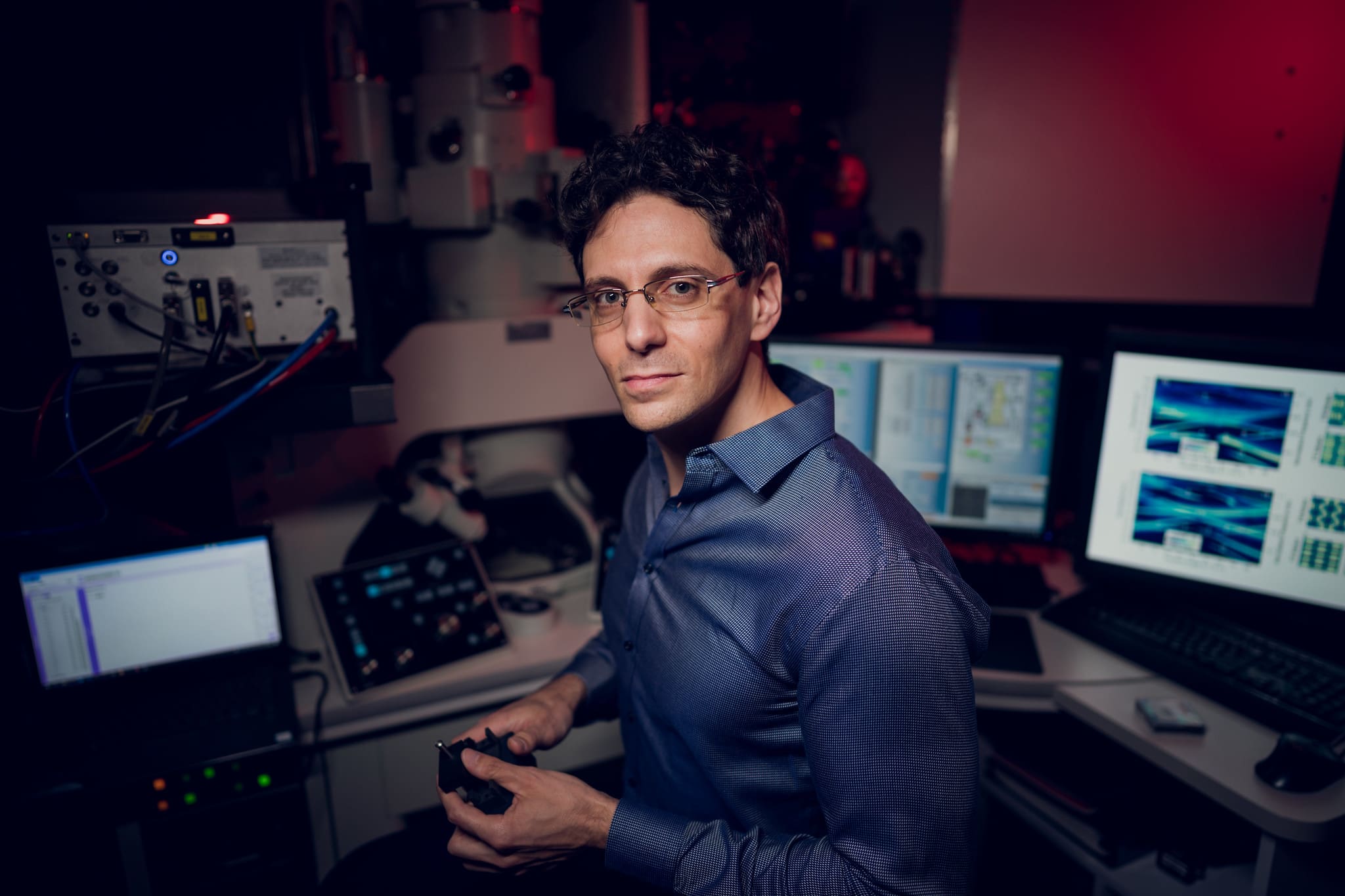
See how a Technion alum-led startup's device is revolutionizing ADHD detection by observing eye movements and startle reflexes in children.
1 min
X (opens in a new tab) / Facebook (opens in a new tab) / LinkedIn (opens in a new tab) / Email / Copy Link
What if diagnosing cancer, Parkinson’s disease, or other serious illnesses could be as simple as breathing into a handheld device? That possibility is moving closer to reality thanks to the work of the Technion’s Prof. Hossam Haick, whose groundbreaking research is changing how diseases are detected around the world. In recognition of his extraordinary achievements, […]
Every year, the European Research Council (ERC) identifies some of the world’s most promising early-career researchers and gives them the freedom to pursue bold ideas. This year, two of those ideas came from the Technion – Israel Institute of Technology. From cancer research to artificial intelligence (AI), breakthroughs that shape the future often begin with […]
As more people turn to AI chatbots for companionship, life advice, or even as a stand-in for therapy, experts say the technology offers both new opportunities and risks when it comes to mental health. Prof. Tanzeem Choudhury is the chief of health innovation in the Joan & Irwin Jacobs Technion-Cornell Institute and has been studying AI and mental health for 15 years. She said AI tools are available any time, often at low cost, making it easier for people to access some form of mental health support.
Stay on top of the latest breaking scientific discoveries from Israel and the Technion. Subscribe to the ATS newsletter.