Podcast

Something Fresh in the State of Denmark

October 06, 2026

Go
cornell tech sign on the jacobs technion cornell institute campus during awards ceremony at cornell tech on roosevelt island, nyc | Donate to Support Israel | Technion University
In The News

The Runway Startup Program Welcomes Its Newest Founders

October 05, 2026
Go
cultivated meat
In The News

How Cultivated Meat Went From the Lab to the Plate

October 05, 2026
Go
Video

Why the Perfect Pitch is Your Biggest Mistake

September 23, 2026
Go
Queen Christina death mystery | historical medical investigation
In The News

The Queen Christina Death Mystery May Finally Have an Answer

October 05, 2026
Go
gum disease diagnosis
In The News

Can AI Safely Support Gum Disease Diagnosis?

October 05, 2026
Go
immune response test
In The News

Reading the Immune Response Instead of the Infection

October 05, 2026
Go
tumor microenvironment | cancer immunotherapy biomarkers
In The News

Not Where a Tumor Starts, but Where It Goes

October 05, 2026
Go
In The News

What Becomes Possible Next?

October 07, 2026
Go
CloudCT satellite | polarized light measurements
In The News

CloudCT Satellite Captures Its First Observation From Orbit

October 05, 2026
Go
AI and Children’s Cognitive Development | generative AI in education
In The News

The Risks of AI and Children’s Cognitive Development

October 05, 2026
Go
AI in education
Article

Rethinking Education in the Age of AI 

September 25, 2026
Go
strength in every step | American Technion Society | Donate to Israel
Article

Strength in Every Step: Recovery, Resilience, and a Walk to Remember

August 21, 2026
Go
Student Resilience | American Technion Society | Donate to Israel
Article

Never Too Late for a New Challenge

August 17, 2026
Go
coexistence | American Technion Society | Donate to Israel
In The News

The Technion’s Model of Coexistence

August 07, 2026
Go
Sirens | American Technion Society | Donate to Israel
Article

When the Sirens Sound

August 07, 2026
Go
Reuven Aronashvili
Video

From a Poor Town to Leading Paradigms in Cyber

September 25, 2026
Go
earthquake rescue | American Technion Society | Donate to Israel
In The News

Israeli Drones Aid Earthquake Rescue Efforts in Venezuela

July 08, 2026
Go
No GPS or Communication Drones flying in the background as a soldier's shadowy silhouette fills the foreground
Video

When GPS Fails, This Drone Keeps Going

June 10, 2026
Go
Article

Technion Innovations: Safeguarding Israel and the World

May 28, 2026
Go
Article

From Technion Student to Technion Professor: How Early Support Helped Build a Lab for Clean Energy Breakthroughs

October 06, 2026
Go
Article

Seeds of a New Community

September 08, 2026
Go
Tree Canopy | American Technion Society | Donate to Israel
In The News

Cornell Tech’s Tree Canopy Project Builds a Cooler New York City

August 11, 2026
Go
Wildfire detection | American Technion Society | Donate to Israel
In The News

Wildfire Detection Takes Flight With AI-Powered Drones

August 04, 2026
Go
In The News

What Becomes Possible Next?

October 07, 2026
Go
Article

Tiny DNA Tweaks, Big Evolutionary Changes 

October 07, 2026
Go
AI and Children’s Cognitive Development | generative AI in education
In The News

The Risks of AI and Children’s Cognitive Development

October 05, 2026
Go
AI in education
Article

Rethinking Education in the Age of AI 

September 25, 2026
Go
In The News

Janet Shatz Begins a New Chapter for ATS

October 06, 2026
Go
Video

Technion: The Vision to Do Good

August 17, 2026
Go
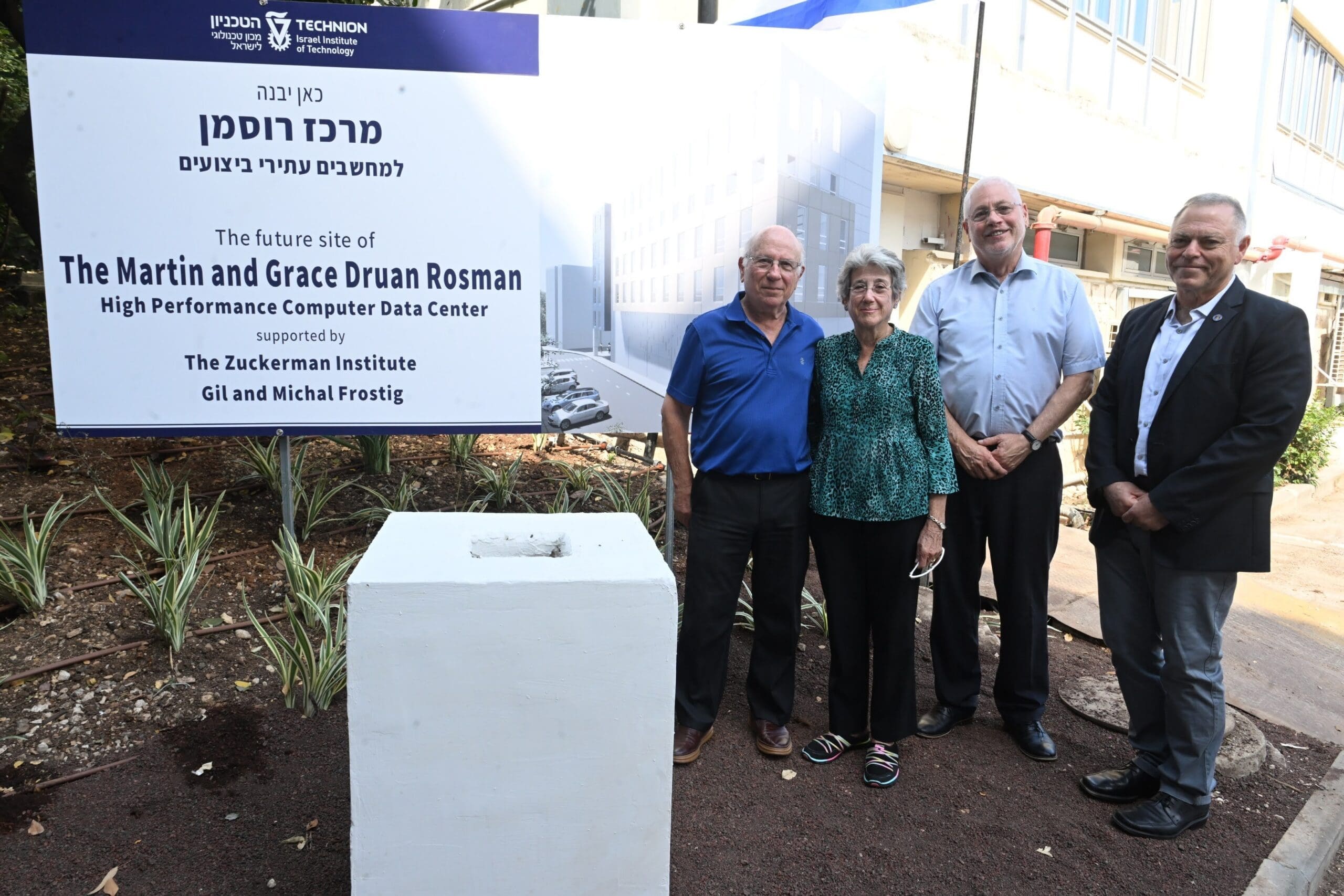
From left: Dr. Martin Rosman; Grace Druan Rosman; Technion President Prof. Uri Sivan; and Dr. Rafi Aviram, executive vice president and director general of the Technion, at the cornerstone ceremony for the Martin and Grace Druan Rosman High-Performance Computer Data Center building. | American Technion Society | Donate to Israel
Article

A Vision Built Around Students

June 29, 2026
Go
1912 - Today | Technion flag with Israeli flag | Donate to Israel | Technion University
Video

1912 to Today: The Institution That Helped Build Israel

June 10, 2026
Go

Watch, Read & Listen

Explore stories, news, insights, and data across articles, videos, and podcasts.

view all content types
Article

Tiny DNA Tweaks, Big Evolutionary Changes 

October 07, 2026
Go
Article

From Technion Student to Technion Professor: How Early Support Helped Build a Lab for Clean Energy Breakthroughs

October 06, 2026
Go
AI in education
Article

Rethinking Education in the Age of AI 

September 25, 2026
Go
disease detection
Article

A Breathalyzer Test for Cancer?

September 17, 2026
Go
Reuven Aronashvili
Video

From a Poor Town to Leading Paradigms in Cyber

September 25, 2026
Go
Video

Why the Perfect Pitch is Your Biggest Mistake

September 23, 2026
Go
Video

When the Newsroom Meets the Algorithm

September 18, 2026
Go
Video

Technion: The Vision to Do Good

August 17, 2026
Go
Podcast

Something Fresh in the State of Denmark

October 06, 2026

Go
Podcast

Predictions from The Himalayas

September 17, 2026
Go
Podcast

Everything In-House

August 11, 2026
Go
the heart | American Technion Society | Donate to Israel
Podcast

The Heart Will Go On

July 15, 2026
Go
In The News

What Becomes Possible Next?

October 07, 2026
Go
In The News

Janet Shatz Begins a New Chapter for ATS

October 06, 2026

Go
cornell tech sign on the jacobs technion cornell institute campus during awards ceremony at cornell tech on roosevelt island, nyc | Donate to Support Israel | Technion University
In The News

The Runway Startup Program Welcomes Its Newest Founders

October 05, 2026

Go
Queen Christina death mystery | historical medical investigation
In The News

The Queen Christina Death Mystery May Finally Have an Answer

October 05, 2026

Go
25 %

of the student body are Arab Israeli

16K +

students

# 97

of all universities in the world*

The Technion’s story has been intertwined with Israel’s for more than a century, from laying the foundations for a new nation to shaping its future.

About ATS

ATS is a community of supporters, innovators, and champions of possibility united by one mission: transforming Israel and the world through science and discovery.

Learn More

About the Technion

For more than 100 years, the Technion has been Israel's technological engine and leading driver of innovation, technology, and entrepreneurship, transforming ideas into impact.

Learn More

The Frontiers of Modern Computing

Technion Prof. Danny Raz explores how quantum computing and AI are reshaping what machines can do and how future computer scientists are educated.

modern computing in an ai rending with purple and blue and grey colors | Donate to Israel | Support the Technion University

While students still need to master basic coding skills and algorithm design, they must also develop the ability to assess whether an AI program solves a problem correctly.”

Prof. Danny Raz

In the field of computer science, profound questions define the boundaries of what machines can do. Are there certain problems that computers cannot solve? What new possibilities do quantum computing and AI enable? How do these expanding frontiers change how we educate the next generation of computer scientists?

In a lecture delivered to the American Technion Society’s National Board of Directors in November 2024, Danny Raz, dean of the Henry and Marilyn Taub Faculty of Computer Science at the Technion, explored these questions as he discussed key issues in modern computing, offering an inside look at the field’s cutting edge.

The Limits of Computing

Prof. Raz invited the audience to engage in a time-honored thought experiment known as the Halting Problem, which asks: Is it possible to create an algorithm that can determine, for any given program, whether the program will eventually stop (halt) or run indefinitely?

He asked the audience to assume that such an algorithm exists, known as a “black box.” He then presented the idea of a new program, called a “green-red box,” which is designed to behave as follows:

  1. If the black box predicts the program will halt, the green-red box runs forever. 
  2. If the black box predicts the program will run forever, the green-red box halts.

Now, he asked, what happens if the green-red box is fed into the black box algorithm — in other words, if the program in question is the green-red box itself?

A contradiction arises. If the black box predicts the program will halt, the green-red box runs forever, based on the green-red box’s behavioral rules. If the black box predicts the program will run forever, the green-red box halts. Reality defies the black box’s prediction.

“We find that the black box is faulty,” said Prof. Raz. “No algorithm can predict the halting behavior of all programs, which reveals real limits to what one can achieve using computers.”

Expanding Horizons

While the Halting Problem defines what computers cannot do, the rise of quantum computing presents an expanding horizon of what they can achieve. Quantum computers, Prof. Raz explained, harness the strange properties of quantum mechanics to process information in ways that classical computers cannot.

Quantum computing deals with quantum bits or qubits, which differ from classical bits in that they can exist in multiple states simultaneously. Unlike classical bits, which are either 0 or 1, qubits leverage the principle of superposition, where they can exist in multiple states at once. This property allows quantum computers to perform calculations over a vast range of possibilities in parallel, enabling them to tackle problems that would take classical computers millennia to solve.

One of the most promising applications of quantum computing, explained Prof. Raz, is in cryptography. Quantum computers can, in theory, break encryption algorithms by efficiently searching through all possible keys. While this remains largely theoretical, quantum computing is already progressing toward realizing this possibility, which has the potential to revolutionize industries like cybersecurity.

“If you have a large enough quantum computer, you could break codes,” he said. “And this is very, very attractive to many of the governments and other forces in the world.”

Tomorrow’s Computer Scientists

As technology evolves, so, too, must the way we educate the next generation of computer scientists, Prof. Raz posited. In the past, computer science education focused heavily on technical skills and problem-solving through traditional algorithms. However, with the rise of AI and machine learning, new educational priorities have emerged, and the Technion is leading the way in preparing tomorrow’s computer scientists with necessary skills.

“One of the key shifts in computer science education is the need to balance practical skills with deep theoretical knowledge,” said Prof. Raz. “While students still need to master basic coding skills and algorithm design, they must also develop the ability to assess whether an AI program solves a problem correctly.”

This is particularly important in today’s tech landscape, he explained, where companies like Google rely on programmers to work closely with AI tools that generate code.

To address this emerging need, Technion educators are incorporating new skills into their curricula, teaching students how to interact with machines like AI-powered code assistants. The goal is to ensure that students understand how to verify whether a machine’s output aligns with the desired outcome.

New Frontiers in Computing

Despite inherent limits to what computers can achieve, quantum computing and AI represent exciting new frontiers in computation. As the field of computer science evolves, so, too, will the way the Technion educates future generations of tech professionals.

“By incorporating both practical skills and theoretical concepts— particularly in the realms of AI and quantum computing — we will prepare Technion students for the future, equipping them with the tools needed to navigate an increasingly complex technological landscape,” said Prof. Raz.

More About Danny Raz

Professor Danny Raz is the dean of the Henry and Marilyn Taub Faculty of Computer Science at the Technion. A member of the Technion faculty since 2000, he holds the Hewlett-Packard Chair in Computer Engineering.

Related Stories

In The News

What Becomes Possible Next?

October 07, 2026

At the Technion, Israel Institute of Technology, the future often begins with a deceptively simple question: What can we do today that we could not do before? “Science and engineering have never been about yesterday’s tasks. They’ve always been about the future,” said Prof. Lihi Zelnik-Manor, vice president of External Relations and Resource Development at […]

Go
CloudCT satellite | polarized light measurements
In The News

CloudCT Satellite Captures Its First Observation From Orbit

October 05, 2026

The first satellite in the CloudCT network has transmitted its first observation from orbit, marking an early milestone for the Israeli-German research project studying clouds and polarized light from space. The image shows a view toward central France as the satellite passed over the Baltic Sea, according to a statement from the Technion – Israel […]

Go
AI and Children’s Cognitive Development | generative AI in education
In The News

The Risks of AI and Children’s Cognitive Development

October 05, 2026

Los Angeles Unified School District recently announced it will bar student use of generative artificial intelligence on school devices for the 2026-27 academic year, joining New York City Public Schools in limiting children’s access to a technology no one yet knows how to safely manage. The nation’s two largest school districts made the move at […]

Go

Love Israel and Science? 

Stay on top of the latest breaking scientific discoveries from Israel and the Technion. Subscribe to the ATS newsletter.

Secret Link