Something Fresh in the State of Denmark
October 06, 2026




























The Technion’s story has been intertwined with Israel’s for more than a century, from laying the foundations for a new nation to shaping its future.
Step inside Israeli innovation at the David and Janet Polak Visitors Center. Experience our 360° immersive movie and tech exhibition. Open to individuals and groups.
Learn More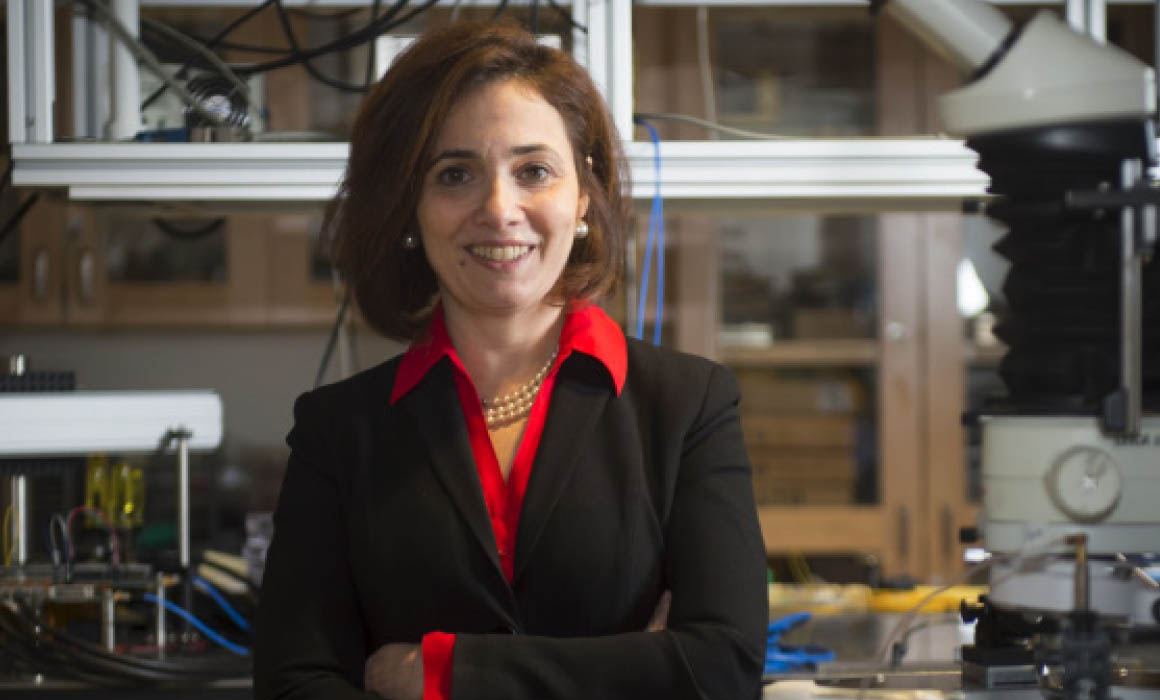
Professor Michal Lipson ’92, M.S. ’95, Ph.D. ’98, is the Eugene Higgins Professor of Electrical Engineering and Professor of Applied Physics at Columbia University, president-elect of the Optical Society, a 2010 MacArthur Fellow, and a pioneer in the field of nanophotonics. More than 1,000 papers published yearly involve devices and circuits based on her research. The Technion is family, as her father and father-in-law were both professors at the university.
M.L. Funny enough, gender discrimination played a role. When I started my career in 2000, the area of silicon nanophotonics, optics printed on chips, didn’t exist. I pioneered this. There were many types of semiconductors that people were working with, such as GaAS (gallium arsenide). But they were difficult to grow. So if I wanted to use these materials as the basis for optics, I felt it would require me to be “in the club.” And being a young woman, I’d never be in the club.
So silicon was easier to work with. I could do it myself. It was easy to grow and easy to buy. Silicon was used then for electronics, but nobody else was using it to transmit light. So I gravitated to silicon nanophotonics as I felt I had the best chance to succeed because I was self-sufficient.
Anything that uses electronics, from toys at McDonald’s to your Mac computer, is based on silicon chips. In photonics, we use the same material but with circuits of light traveling through the chips.
Silicon chips in your laptop are very complicated. They have one processor on the right end of the chip, another processor, or computing mode, on the left, and they need to talk to each other. So a wire goes across the chip to connect them, but these wires heat up your computer and are limited to how much information they can transmit. They are being replaced by nanophotonic fibers, just one-thousandth of a hair in width, that can carry an enormous amount of information by light, quickly, without getting hot.
In the company that I co-founded, Voyant Photonics, we are applying nanophotonic and LiDAR (light detection and ranging) technology to develop autonomous vehicles. The technologies can also be applied to medical and environmental sensors, and are already used today in data processing centers.
I’m often asked, “How do you wine and dine? How do you make connections?” I always recommend staying away from networking, at least in the beginning. We’re in applied physics and engineering, so success can be quantified without discussion. It’s not “she’s good or not good,” but “she demonstrated the bandwidth in X number of bits per second.” If you are really good you don’t need to network. You have your number and everybody knows how you got it. The work will speak for itself. As a woman, it’s easier to rely on these metrics of success than on networking.