Something Fresh in the State of Denmark
October 06, 2026


































The Technion’s story has been intertwined with Israel’s for more than a century, from laying the foundations for a new nation to shaping its future.

Step inside Israeli innovation at the David and Janet Polak Visitors Center. Experience our 360° immersive movie and tech exhibition. Open to individuals and groups.
Learn More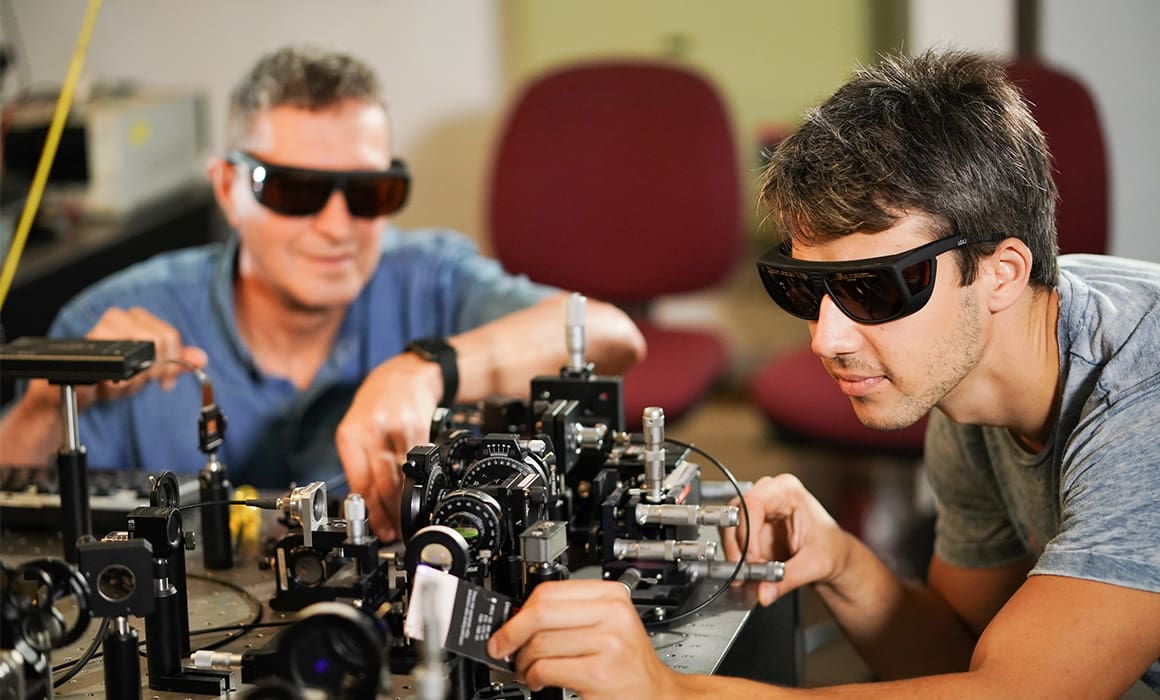
An interdisciplinary team of scientists led by Distinguished Professor Mordechai Segev of the Technion’s Physics Department and Solid State Institute and Professor Erez Hasman of the Technion’s Faculty of Mechanical Engineering has developed a new and innovative scientific field: quantum metamaterials.

What Are Metamaterials?
Metamaterials are artificial materials designed to control the electromagnetic properties of a medium. Metasurfaces are the two-dimensional version of metamaterials: extremely thin surfaces made up of numerous subwavelength optical nanoantennas, each designed to serve a specific function upon the interaction with light.
Until this discovery, experimentation with metamaterials was limited to manipulations using classical light. For example, using classical light, researchers have designed invisibility cloaks that can conceal small things from radar, or create a medium that bends light backwards.
This new breakthrough harnesses artificial nano-designed metamaterials to generate and control quantum light. Soon, those metamaterials could become the building blocks for quantum optics and quantum information.
The key to the researchers’ discovery? A dielectric metasurface, which acts differently in response to left- and right-handed polarized light. Dielectric metasurfaces impose polarized light on opposite phase fronts that look like screws, one clockwise and one counterclockwise. If the metasurface wasn’t nano-fabricated from transparent materials, the quantum properties would be destroyed.
The Experiments
The team conducted two sets of experiments to generate entanglement between the spin and orbital angular momentum (OAM) of photons, the particles that make up light.
Researchers shone a laser beam through a nonlinear crystal to create single photon pairs. Each is characterized by zero orbital momentum, and each had linear polarization — a superposition of right-handed and left-handed circular polarization, which correspond to positive and negative spin.
In the first experiment, the scientists split the photon pairs — directing one through a unique fabricated metasurface and the other to a detector to signal the arrival of the other photon. They measured the single photon that passed through the metasurface and found that it acquired OAM and the OAM became entangled with the spin.
In the second experiment, the photon pairs were passed through the metasurface and measured using two detectors to show they had become entangled.
What Is Entanglement, and Why Does It Matter?
In the simplest of terms, entanglement means the actions performed on one photon simultaneously affect the other, even when the photons are very far apart. In quantum mechanics, photons are believed to exist in both positive and negative spin states, but once measured adopt only one state.
Another way of looking at it: Imagine you have two boxes, each with a red ball and a blue ball inside. If the boxes aren’t entangled, you can reach into the box and pull out either a red or a blue ball. But if the boxes were entangled, the ball inside the box could be red or blue, but it will only be determined at the moment you see one of the balls in the box.
What’s Next for Quantum Metamaterials
By applying metamaterials to quantum information and computing, the Technion team has paved the way for numerous practical applications, including unbreakable encryptions. Their discovery also opens the door for new possibilities for quantum information on chips.