The Technion’s story has been intertwined with Israel’s for more than a century, from laying the foundations for a new nation to shaping its future.

From medicine to security, explore how the Technion is advancing Israel and improving lives around the world.
View All Impact Areas
Explore stories, news, insights, and data across articles, videos, and podcasts.
view all content types
among universities worldwide for producing undergrad entrepreneurs
of the student body are Arab Israeli
students
The Technion’s story has been intertwined with Israel’s for more than a century, from laying the foundations for a new nation to shaping its future.
Explore ATS, the Technion, and the people behind the breakthroughs redefining what's possible for Israel and the world.
Learn More About ATSATS is a community of supporters, innovators, and champions of possibility united by one mission: transforming Israel and the world through science and discovery.
Learn MoreFor more than 100 years, the Technion has been Israel's technological engine and leading driver of innovation, technology, and entrepreneurship, transforming ideas into impact.
Learn More
Step inside Israeli innovation at the David and Janet Polak Visitors Center. Experience our 360° immersive movie and tech exhibition. Open to individuals and groups.
Learn MoreFrom medicine to security, explore how the Technion is advancing Israel and improving lives around the world.
View All Impact AreasExplore stories, news, insights, and data across articles, videos, and podcasts.
view all content typesDiscover ways to support, connect, and help drive innovation.
Get InvolvedExplore ATS, the Technion, and the people behind the breakthroughs redefining what's possible for Israel and the world.
Learn More About ATS
Scientists at the Technion have come upon a surprising discovery that could help frustrated would-be fathers determine their fertility. If validated in humans, this discovery could lead to a reliable, fast, and simple method for diagnosing male infertility, and “could predict the success of assisted reproductive techniques such as IVF or evaluate the fertility of stud animals,” said Technion Professor Benjamin Podbilewicz.
The result came unexpectedly, when baby hamster kidney cells surprisingly merged into a single giant cell with multiple nuclei. Scientists discovered that the ability of mice sperm to merge those cells corresponded to the sperm’s fertilizing potential – the more nuclei in the giant cell, the greater the sperm’s fertility.
Today, sperm fertility is evaluated by sperm count and concentration, morphology (shape), and motility. If those parameters are fine but infertility persists, the traditional hamster egg penetration test had been used to determine whether the sperm is capable of entering and fusing with the egg. But that test has proven to be unreliable and is now considered obsolete.
In their new work, Prof. Podbilewicz with postdoctoral researcher Nicolas Brukman, and lab manager Clari Valansi, sought to better understand how mammalian sperm fuses with eggs. The team started by incubating sperm from adult mice with baby hamster kidney (BHK) cells that had been genetically modified to express a protein on human egg known as JUNO. Surprisingly, the sperm cells induced the BHK cells to fuse together and form one giant cell with multiple nuclei. This helped the researchers determine that producing this monster cell was dependent on the presence of the protein JUNO.
But more work was needed to understand the process. For example, did the formation of the big cell require JUNO to be present on both fusing BHK cells?
After a series of experiments, the team’s work suggested that indeed all of the BHK cells needed to express JUNO, and the sperm must express a protein known as IZUMO. With the addition of JUNO, these hamster cells more closely resemble human egg cells, making the process, dubbed SPICER, or Sperm-Induced Cell-cell fusion Requiring JUNO, a better indication of male fertility than the traditional egg penetration test.
The co-inventors have published their findings in eLife (opens in a new tab) and have filed a patent application.
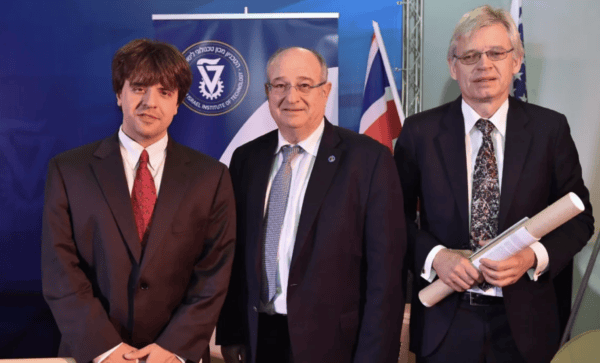
Top photo: From left to right: Nicolas Brukman, Clari Valansi, and Prof. Benjamin Podbilewicz
March 06, 2024
Learn how Technion scientists are uncovering new methods to assess male infertility, potentially improving IVF outcomes for couples.
1 min
X (opens in a new tab) / Facebook (opens in a new tab) / LinkedIn (opens in a new tab) / Email / Copy Link
Biotech / Faculty / Natural Sciences / Students / Technion Institutional /
What if diagnosing cancer, Parkinson’s disease, or other serious illnesses could be as simple as breathing into a handheld device? That possibility is moving closer to reality thanks to the work of the Technion’s Prof. Hossam Haick, whose groundbreaking research is changing how diseases are detected around the world. In recognition of his extraordinary achievements, […]
Every year, the European Research Council (ERC) identifies some of the world’s most promising early-career researchers and gives them the freedom to pursue bold ideas. This year, two of those ideas came from the Technion – Israel Institute of Technology. From cancer research to artificial intelligence (AI), breakthroughs that shape the future often begin with […]
As more people turn to AI chatbots for companionship, life advice, or even as a stand-in for therapy, experts say the technology offers both new opportunities and risks when it comes to mental health. Prof. Tanzeem Choudhury is the chief of health innovation in the Joan & Irwin Jacobs Technion-Cornell Institute and has been studying AI and mental health for 15 years. She said AI tools are available any time, often at low cost, making it easier for people to access some form of mental health support.
Stay on top of the latest breaking scientific discoveries from Israel and the Technion. Subscribe to the ATS newsletter.