Something Fresh in the State of Denmark
October 06, 2026






























The Technion’s story has been intertwined with Israel’s for more than a century, from laying the foundations for a new nation to shaping its future.

Step inside Israeli innovation at the David and Janet Polak Visitors Center. Experience our 360° immersive movie and tech exhibition. Open to individuals and groups.
Learn More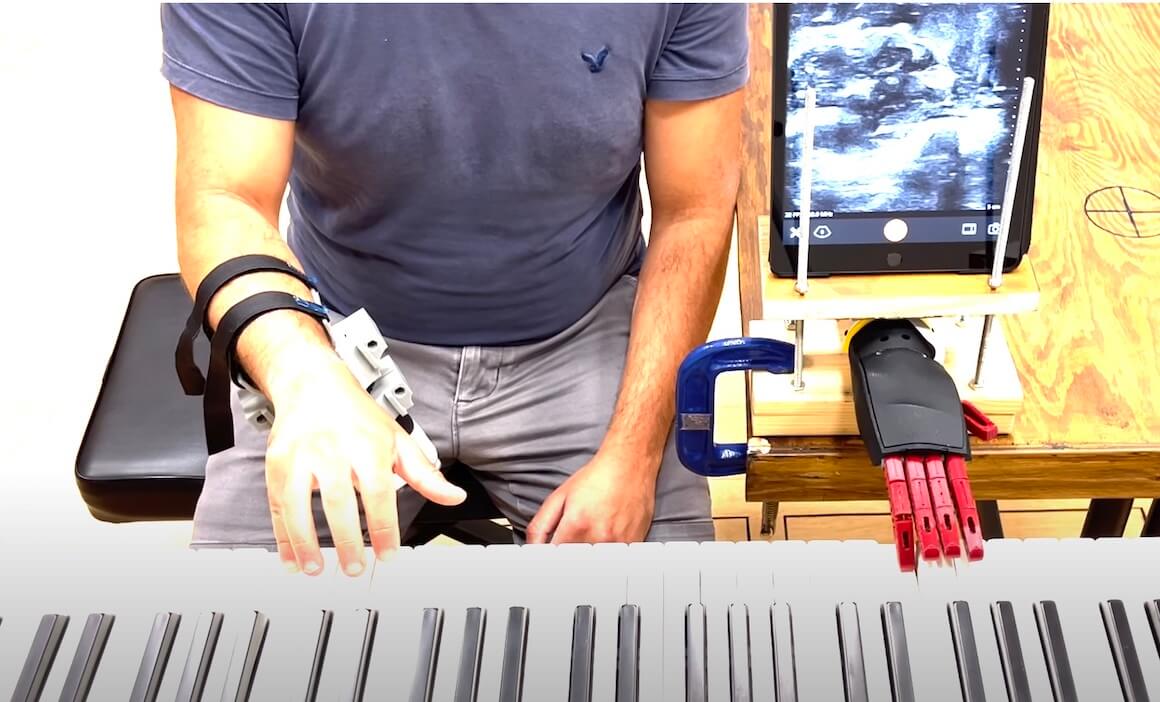
Despite advances in technology, providing amputees with prosthetics that mimic real limbs is an ongoing challenge. They may be more aesthetically pleasing than they used to be but are not necessarily practical. For example, a prosthetic hand may help wearers hold a cup and drink from it, but making the coffee, using a computer, or playing the piano involves much more complexity.
“Many people who have lost a hand give up on the prosthesis after a short period because it is heavy, cumbersome, and its effectiveness is very limited,” said Dean Zadok, a Ph.D. student in the Henry and Marilyn Taub Faculty of Computer Science. “We are trying to develop lightweight, comfortable, and efficient solutions” that enable precise and sensitive hand actions and finger movements.
Zadok developed a robotic hand that allows the wearer to play the piano and type on a keyboard. His system uses ultrasound that reads muscle movements. It was developed with three Technion faculty members: Professor Alon Wolf, a robotics and biomechanics expert from the Faculty of Mechanical Engineering, Professor Alex Bronstein (computational learning), and Dr. Oren Salzman (robotics), both from the Faculty of Computer Science.
The device attaches to the forearm and interprets the user’s intentions based on muscle movements, including complicated and fine gestures. Most smart prosthetics currently rely on sensor stickers attached to the skin to interpret muscle signals.
According to Zadok, “This technology is very limiting, and what we are proposing is a new approach based on ultrasound, providing real-time dynamic information about relevant muscle movements for hand and finger motions.”
The researchers are currently working on enhancing the hand’s capabilities. They believe this significant leap will substantially advance the field of prosthetics, providing many users with an improved quality of life.
Dean Zadok received both his bachelor’s (’19) and master’s (’22) degrees in computer science from the Technion. He began his work on the ultrasound solution during his graduate studies, where he volunteered in Prof. Wolf’s lab and at Haifa 3D (opens in a new tab), a nonprofit that provides free 3D-printed prosthetic hands to Israeli children. He also spent the summer of 2023 at the Carnegie Mellon University Robotics Institute as a visiting scholar.
“I always wanted to apply my knowledge for the benefit of human health. Algorithms find their application in a variety of fields, and I am glad I could harness it for the important topic of improving prosthetics for those who have suffered.”
This research is supported by the European Research Council, Israel’s Ministry of Science and Technology, the Israel-U.S. Binational Science Foundation, the David and Lucile Packard Foundation, and the Wein Family Foundation.