Something Fresh in the State of Denmark
October 06, 2026
























The Technion’s story has been intertwined with Israel’s for more than a century, from laying the foundations for a new nation to shaping its future.

Step inside Israeli innovation at the David and Janet Polak Visitors Center. Experience our 360° immersive movie and tech exhibition. Open to individuals and groups.
Learn More

“Nearly all dwellings and buildings require heating and cooling, now more than ever in the face of climate change,” says ThermoTerra. “The increasing use of air conditioners transfers heat from the inside to the outside of buildings, and this in addition to the CO2 emissions resulting from air conditioning energy use only exacerbates the problem.” To address this, the company has developed a cooling and heating technology that avoids CO2 emissions and heating the environment and uses carbon capture materials. Its pilot structure at Ben-Gurion University demonstrated passive cooling continuously to 24°C (75F) solely using water collected from the relatively…

The development of high-performance alternatives to silicon in microelectronics has been brought nearer by researchers at the Technion-Israel Institute of Technology in Haifa who stretched an oxide material at an atomic level, thus controlling its conductivity. They said this is a “milestone advancement towards making efficient switches, which are the basic building blocks of computer chips.” Researchers in the Viterbi Faculty of Electrical and Computer Engineering have been able to control an emerging material that they regard as a possible future alternative to silicon in microelectronics. This is a timely development, because scientists and engineers face challenges in continuing the transistor shrinking…

Israeli company QD-SOL has quite a few things going for it. Not only is it working to produce completely green hydrogen – the renewable energy’s sector game-changing card and biggest buzzword – but it is also backed by none other than Hollywood star and sustainability entrepreneur Ashton Kutcher. “Almost the entire hydrogen production industry is a polluting industry. After it’s produced, hydrogen is an excellent, green energy provider, but it’s usually made by burning gasses that also release a lot of carbon dioxide together with the desired hydrogen,” QD-SOL CEO Gil Davidman tells ISRAEL21c. “The world’s already decided to take steps toward net zero…

Prof. Gideon Grader from Israel’s Technion-Israel Institute of Technology was recently awarded the Grand Prix Scientifique research grant by the Institut de France for developing innovative green hydrogen technology. The Institut de France, a nonprofit organization founded in 1795 that unites five French academies, encourages research, supports creativity, and funds many humanitarian projects. Grader has developed a process — dubbed E-TAC — along with his Technion colleagues, which splits water into hydrogen and oxygen by decoupling the production of the two gasses. This is achieved by circulating electrolyte solutions at different temperatures through the electrodes.

Titanium-air batteries have been recently tested by a team of scientists from Technion – Israel Institute of Technology and Forschungszentrum Jülich, and the results are promising. These batteries have the potential to store up to three times more energy than standard batteries, making them a great candidate to replace current zinc-air batteries used in small devices such as hearing aids and other sensors. The breakthrough in utilizing an ionic liquid to enhance the battery’s efficiency and longevity means that these batteries could be a significant upgrade to the zinc-air batteries currently used in hearing aids. These batteries have a limited lifespan and can…

Researchers have theorized a new mechanism to generate high-energy “quantum light,” which could be used to investigate new properties of matter at the atomic scale. The researchers, from the University of Cambridge, along with colleagues from the U.S., Israel and Austria, developed a theory describing a new state of light, which has controllable quantum properties over a broad range of frequencies, up as high as X-ray frequencies. Their results are reported in the journal Nature Physics. The world we observe around us can be described according to the laws of classical physics, but once we observe things at an atomic scale,…

Startup H2Pro, founded by Technion scientists, has signed an agreement with Morocco’s Gaia Energy to co-develop a gigawatt-scale “green” hydrogen energy project — a potential boon for promoting economic ties between the two countries and combatting climate change. “Climate change is the greatest challenge facing our generation, and it can only be solved by reaching across borders with seamless coordination between the private and public sector,” said Talmon Marco, CEO of H2Pro. The technology at the core of H2Pro was developed by Professors Avner Rothschild and Gideon Grader and Drs. Hen Dotan and Avigail Landman in the Nancy and Stephen…

Electric vehicles (EV) are surely a greener mode of transportation than gas-guzzling cars, buses, and trucks. But batteries are expensive, recharging takes longer than filing up at the pump, and charging stations are scarce, which can spark fear of getting stranded. Alumnus-founded Electreon has come up with an ingenious solution. Electrify the roads so our EVs can recharge while we are driving. The company, started in 2013 by Oren Ezer M.S. ’06, has been piloting its smart road technology in Israel and Europe. Now, they are rolling out in Detroit — the heart of the U.S.’s automotive industry. “As transportation…
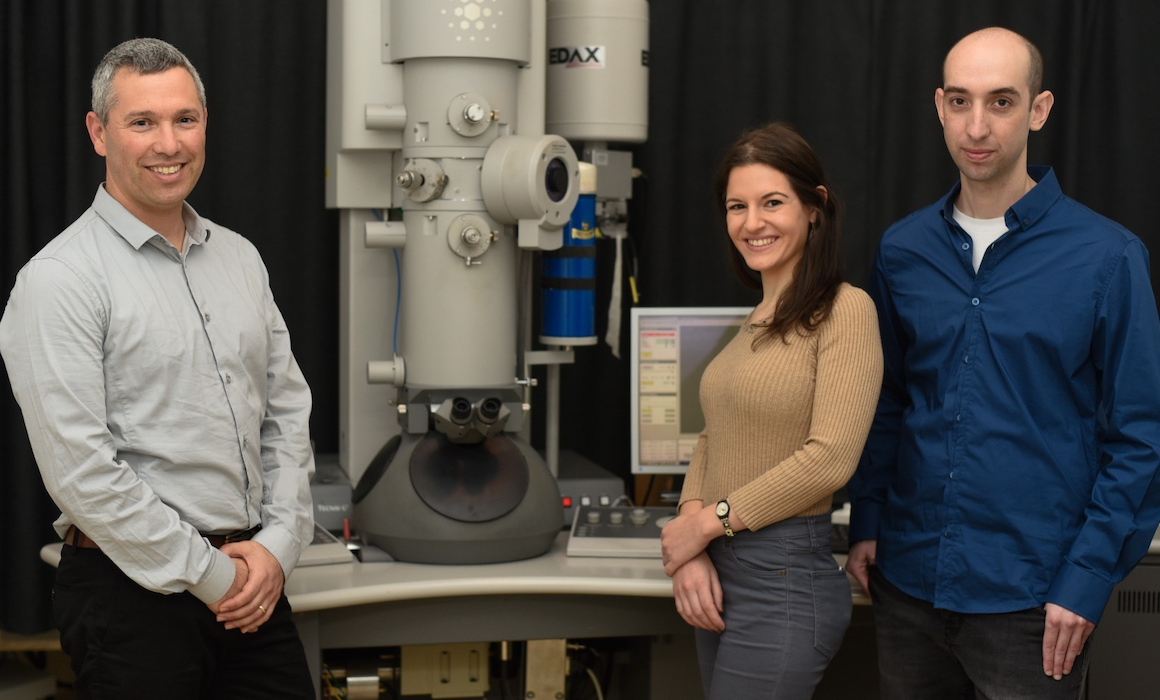
Pictured Above / ( L-R): Professor Yehonadav Bekenstein, Sasha Khalfin, and Noam Veber (Credit : Rami Shelush) What if damaged solar panels or even the cracked screen of your cell phone could heal themselves overnight? Technion scientists have developed self-repairing nanocrystals that might make that scenario a reality. Led by Assistant Professor Yehonadav Bekenstein of the Faculty of Material Sciences and Engineering, the researchers happily stumbled upon the discovery while searching for an environmentally friendly alternative to toxic lead-based perovskites, materials that are commonly used in solar panels. The scientists were using a transmission electron microscope (TEM) to take videos…
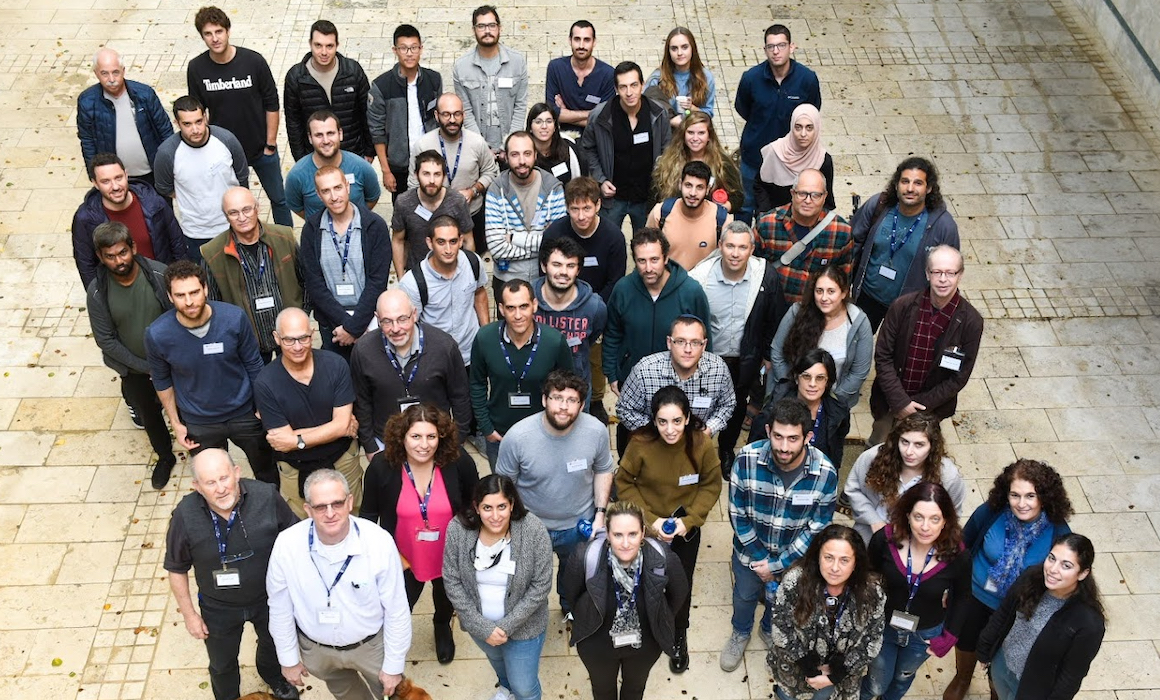
Pictured Above / 2021 GTEP Research Day participants. Every year, the Nancy and Stephen Grand Technion Energy Program (GTEP) invites graduate students to share their research during its Research Day. Prizes were awarded for the most innovative findings. Eliyahu Farber, who developed new methods for the precise production of porous carbon materials, shared the first prize. These porous carbon materials can be used in a variety of applications, including batteries, supercapacitators, and fuel cells. Inbal Offen-Polak also won first prize for research on low cost catalysts for urea oxidation, a useful process with applications in water treatment, hydrogen production, and…

Pictured Above / Technion researchers have developed a new method that harvests an electrical current directly from seaweed in an environmentally friendly and efficient fashion. Technion Ph.D. candidate Yaniv Shlosberg was walking on the beach one day when he noticed a rock covered by seaweed that looked like electrical cords. He had been researching a type of bacteria that obtained energy through photosynthesis and thought that maybe this sun-loving seaweed could also produce electrical currents. Using that common seaweed, called Ulva, as a source of energy, Shlosberg and a team of researchers from the Technion and the Israel Oceanographic and…

How can Israel, a land of 60% desert, use more than 100% of its available water and still have more for the future? Hear renowned water expert Prof. Furman talk about the ingenious technologies that made Israel a world leader in water conservation. This webinar was moderated by Rob Davidow. ABOUT THE SPEAKERProfessor Alex Furman […]