The Technion Confronts Global Antisemitism
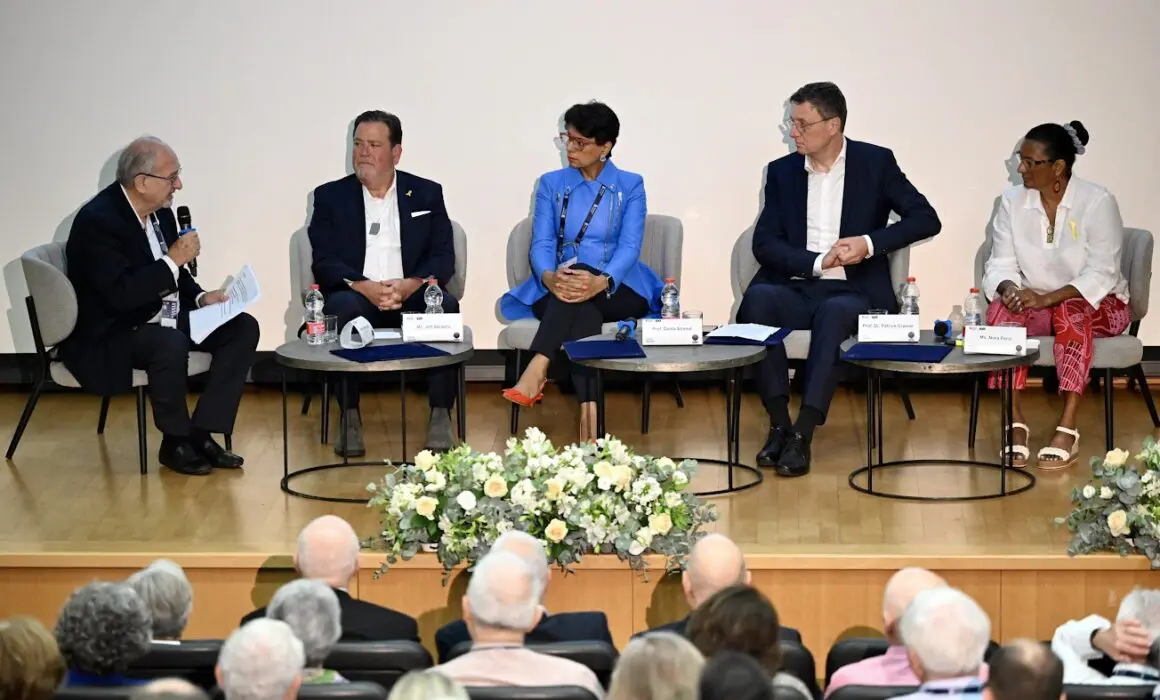
During the Technion’s Centennial Board of Governors Meeting in June, Prof. Uri Sivan bestowed the President’s Award for Exceptional Achievement on four leaders from academia, science, and human rights advocacy for their efforts to combat antisemitism and defend the State of Israel. Following the ceremony, the distinguished honorees participated in a panel on confronting the rising tide of antisemitism.
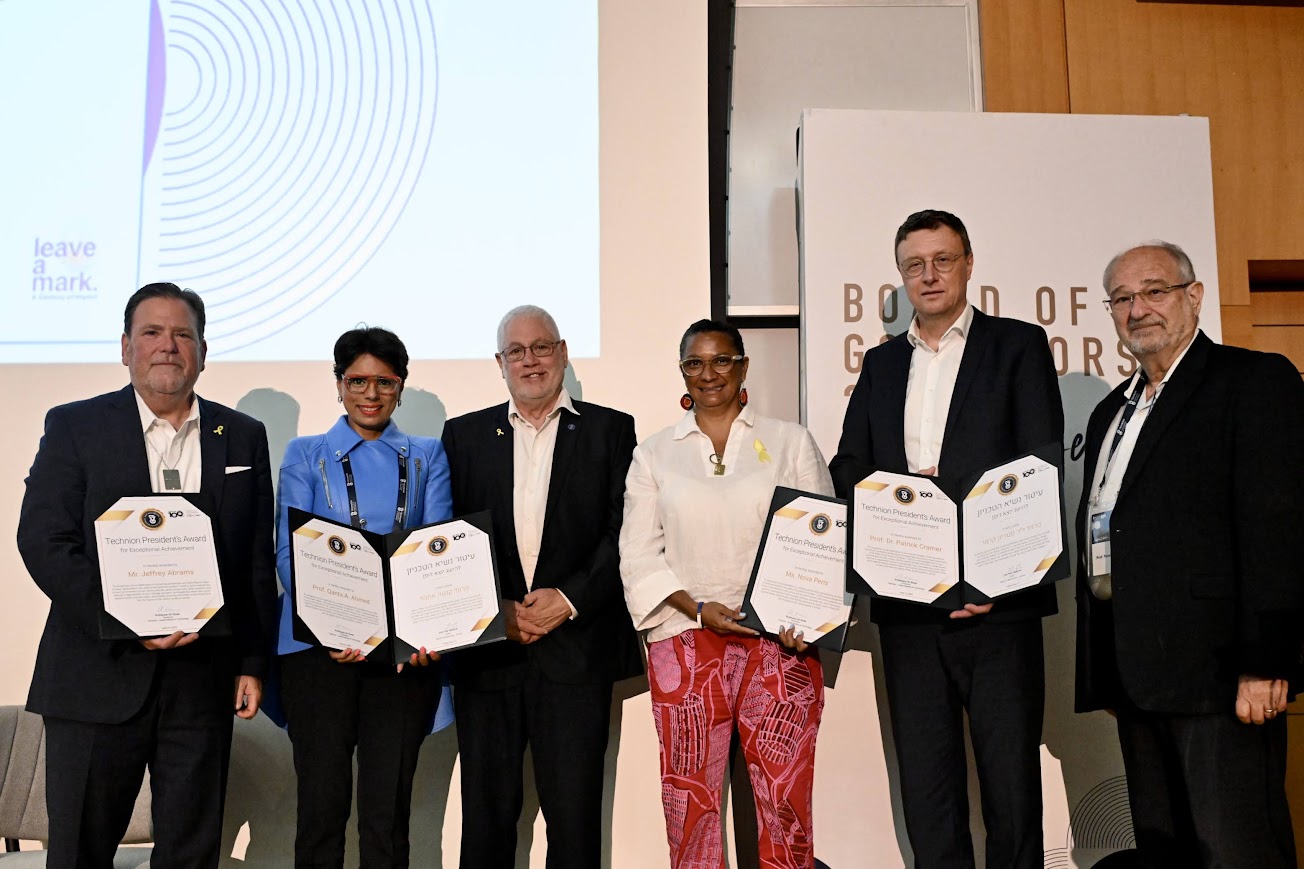
Award recipients, from left: Jeffrey Abrams; Prof. Qanta Ahmed; Prof. Uri Sivan; Nova Peris; Prof. Patrick Cramer; and Prof. Peretz Lavie.
A Global Surge in Hate
Beginning the award ceremony, Prof. Sivan, president of the Technion, set the tone with a stark reminder: “Antisemitism is an ancient malady, as old as Judaism itself.” He traced its evolution from historical prejudice to modern manifestations, exacerbated after the October 7, 2023, Hamas attacks and the ensuing war. “Already on October 7, even before the war had begun, antisemitism reared its ugly head once more,” he said, condemning the “well-funded pro-Palestinian organizations and terror states” that fuel hatred.
Prof. Sivan also warned of a troubling shift in academia. “If last year was mostly a boycott by individuals, in the past half year or so it changed to an institutional boycott, particularly in Australia, Europe, and Canada.”
Professor Emeritus Peretz Lavie, past president of the Technion, moderated the panel discussion, asking the award recipients to share their efforts on denouncing antisemitism and academic boycotts of Israeli institutions, and suggestions on ways to combat them:
“In cities across Europe, America, and even Asia, ‘Free Palestine’ has become a rallying cry for violence against Jews, synagogues, and communities. This is antisemitism in a new guise. In this panel, we will learn from our guests about their experiences, perspectives, and strategies to act against it.”
Professor Emeritus Peretz Lavie
Science As a Bridge
Prof. Patrick Cramer, president of the prestigious Max Planck Society in Germany, spoke of science as a force for unity. “We will never forget that it was Israeli colleagues who reached out to us in 1959 after the Shoah,” he said. Under his leadership, the Max Planck Society opened an office in Jerusalem and reaffirmed its opposition to academic boycotts.
“Our drive for collaboration with Israel is rooted in excellence,” he said. “Israeli academia produces top-quality science. While many around the world believe this is the time to sever ties with Israel, we believe that strengthening scientific bridges is vital for all parties.”
Prof. Cramer stressed the importance of maintaining Israel’s inclusion in the European research consortium and building transatlantic scientific partnerships. He condemned academic boycotts as misguided and dangerous. “We have to be able to differentiate between the politics of a government and our colleagues in academia,” he said. “Science must remain a global, inclusive endeavor.
“We are building a German-Israeli-American consortium aimed at strengthening science and preventing a brain drain — not from countries but from the scientific community itself. This must be an international effort because the conflict is not between national academies but between the voice of science and reason and the forces of anti-science.”
The Academic Front Line
Jeffrey Abrams, regional director of ADL in Los Angeles, addressed the crisis on American campuses. “This has been a cancer growing for decades,” he said. “The last academic year, we saw an abdication of leadership by university presidents and chancellors.” They failed in both their moral and legal obligations to keep their campuses safe, he said.
Abrams highlighted the role of radicalized student groups like Students for Justice in Palestine (SJP), which distributed toolkits only days after October 7. “It was not student language — it was radical Islam; it was Hamas language,” he said. Yet he also offered hope, citing new university leaders like UCLA’s Chancellor Julio Frenk, who took decisive action against SJP after they vandalized the home of a Jewish UC trustee, banning the group from campus. “It takes leaders,” he said. “And we are seeing more leadership — if we demand it.”
Abrams, an attorney, also emphasized the importance of legal tools, such as Title VI of the U.S. Civil Rights Act, which mandates that federally funded institutions protect students from discrimination. “It’s a powerful tool,” he said, “and it’s finally being used to protect Jewish students.”
But legal enforcement alone is not enough. Abrams stressed the need for strategic messaging. He called for data-driven, culturally sensitive communication that avoids reinforcing antisemitic tropes. He warned against promoting accomplishments like the number of Jewish Nobel laureates, for example. “Simply trumpeting Jewish achievements doesn’t help — it can even backfire.”
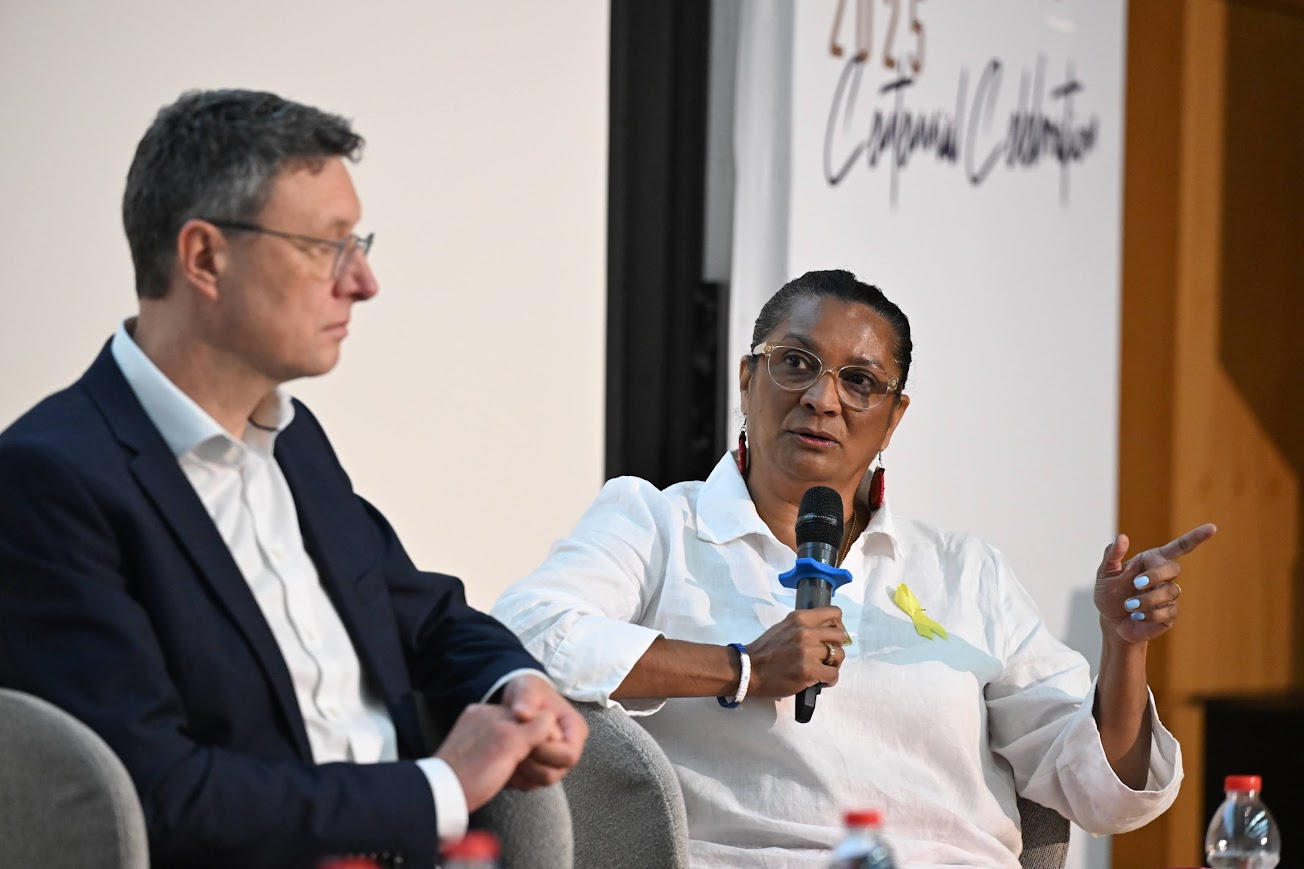
Nova Peris and Prof. Patrick Cramer
Courageous Voices of Solidarity
Nova Peris, the first Aboriginal Australian Olympic gold medalist and a former parliamentarian, drew parallels between Aboriginal and Jewish histories. “Two ancient peoples, two survivors of dispossession,” she said, “our histories are marked by pain, but our futures are shaped by hope.” Peris emphasized the Jewish people’s connection to Israel and condemned the misinformation that fuels antisemitism. “There is no apartheid here. What there is, is a nation defending itself with surgical precision against terrorism.” She called for historical education to dismantle false narratives and build solidarity. Her words underscored a broader theme of the event: Combating antisemitism requires not only truth, but also the courage to speak it — especially when it is unpopular.
Professor Qanta Ahmed, a Pakistani-born American Muslim and human rights advocate, has demonstrated great courage to speak the truth for many years. A professor of medicine at NYU Grossman Long Island School of Medicine and a prolific columnist and media commentator, she offered a powerful condemnation of radical Islamism. “It is a deeply religious obligation as a believing Muslim to denounce this as anathema,” she said. Prof. Ahmed warned of the growing influence of the Muslim Brotherhood in Western democracies, citing a French government report exposing a global plan to embed radical Islam in French society via education and social support, funded by Qatar and Saudi Arabia, laundered through Brussels to appear legitimate.
“We must understand: This plan is led by the Muslim Brotherhood. They are absolutely interested in capturing the youth,” she said, urging vigilance and education. Her call to action was clear: Governments and institutions must educate themselves on the ideological roots of Islamist antisemitism and cut off the funding that enables it.
“Western democracies have been incredibly naive,” she warned, “receiving money that fuels radicalization under the guise of religious freedom.”
Professor Qanta Ahmed
She also said she urges Muslim communities to reject radical Islamist ideologies and expose their infiltration into democratic institutions.
The event concluded with a shared commitment to truth, education, science, and solidarity. As Nova Peris declared, “Knowing your historical truth is everything. And I will take this truth back to my country to knock down antisemitism.”
More Visionary Education stories
Technion Ranked First in Israel and Europe for Computer Science

Researchers Document Cosmic Rays For the First Time