Something Fresh in the State of Denmark
October 06, 2026




























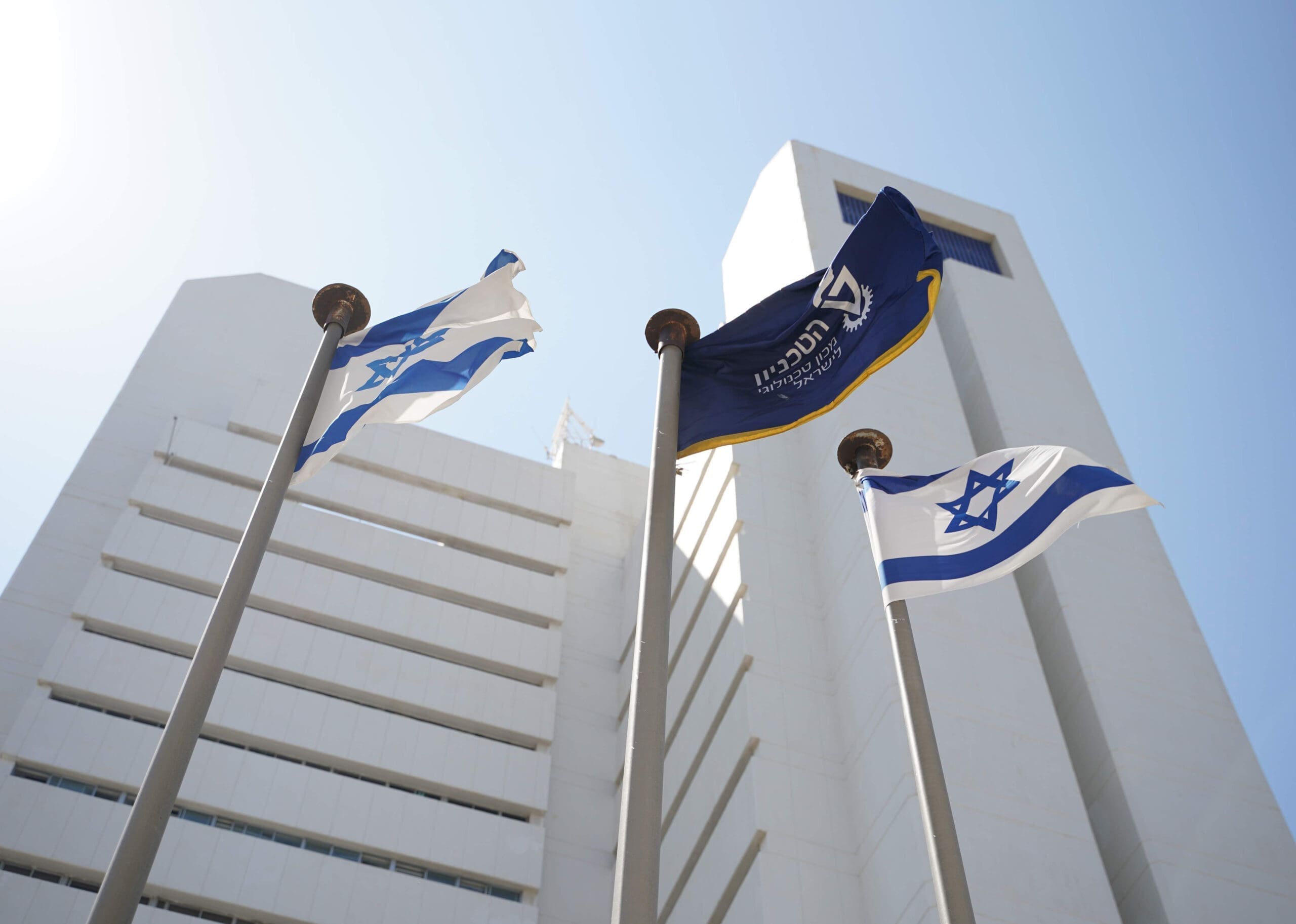






The Technion’s story has been intertwined with Israel’s for more than a century, from laying the foundations for a new nation to shaping its future.

Step inside Israeli innovation at the David and Janet Polak Visitors Center. Experience our 360° immersive movie and tech exhibition. Open to individuals and groups.
Learn More

To bring a new drug to market costs on average $1.3 billion, according to a recent report in the Journal of the American Medical Association, and takes up to 20 years. These astronomical sums do factor in the billions of dollars and years of research invested in what potentially promising therapies that ultimately lead nowhere, according to David Harel, the co-founder and CEO of CytoReason, an Israeli startup using AI and reams of data on the human body to create computational models of diseases affecting mankind. “Developing new drugs is very, very expensive. And the reason it’s expensive is not only…

In December, the Technion – Israel Institute of Technology will celebrate 100 years. Looking at the list of achievements over the years makes you realize how significant its contribution to the state’s development has been – and still is. “For many years we were essentially the only engineering school in the country, and to this day we are the only technological university,” the Technion president, Prof. Uri Sivan, tells Israel Hayom in a special interview. “To a large extent, we shouldered the burden of founding the state on our shoulders, and over the years we have all reaped the rewards for this….

Scientists throughout the world are seeking ways to develop greener power sources. Both solar and wind energy solutions are great alternatives to fossil fuels when conditions are sunny or windy, but figuring out how to store energy for use when the weather doesn’t comply is the big challenge. Hydrogen fuel cells have great potential for energy storage and conversion, but they remain highly expensive to operate. Now thanks to a collaboration between scientists at the Technion and Stanford University, a major obstacle has been overcome. “This solution has great benefits for the research of fuel cells in academia as well…

Scientists led by Nanyang Technological University, Singapore (NTU Singapore) have developed and simulated a new energy-efficient way to generate highly focused and finely controlled X-rays that are up to a thousand times more intense than those from traditional methods. The findings are published in the journal Light: Science & Applications. This paves the way for ultra high-quality X-ray imaging that uses powerful X-rays for detecting flaws in semi-conductor chips accurately. The new method could also allow more focused X-ray imaging to be done for health screening while using less energy. The novel method is based on computer simulations that shoot electrons at an ultra-thin…

In a study conducted at the University of Twente, Technion-Israel Institute of Technology and the Open University of Israel, researchers have developed a novel approach to address the environmental challenges posed by perchlorate salts, which have been identified as persistent pollutants with potential impacts on human health. The researchers published their findings in an article titled “Selective Perchlorate Sensing Using Electrochemical Impedance Spectroscopy with Self-Assembled Monolayers of semiaza-Bambusurils,” in the journal Chemistry—A European Journal. Perchlorate salts are a type of anion—slightly negatively charged molecules—which have raised concerns due to their ability to interfere with the proper functioning of the thyroid gland, leading to…

Researchers at the Technion – Israel Institute of Technology in Haifa have developed a new tool to determine whether a cancer patient is predisposed to an advanced kind of treatment called immunotherapy. The immune system contains “checkpoints” to prevent it from attacking cancer cells too strongly, as this would also potentially damage nearby healthy cells. Immune checkpoint inhibitors (ICI) suppress this action and allow the immune system to attack the cancer cells, but they are only effective in less than 40 percent of patients and tools currently being used to predict the drug’s efficacy are not completely accurate. Keep reading at nocamels.com.

Three Israeli research projects have won a $1 million prize for initiatives tackling the climate crisis. The prize is designed to advance groundbreaking innovation and research that will reduce greenhouse gas emissions. The Climate Solutions Breakthrough Research Prize is awarded by the Jewish National Fund of Canada with the support of Keren Kayemet LeYisrael (KKL-JNF), with each making a matching contribution to the prize money. The prize was also awarded in conjunction with Startup Nation Central, a nonprofit dedicated to promoting Israeli innovation. The winners are: Prof. Shany Barath and Prof. Yechezkel Kashi from the Technion – Israel Institute of Technology in Haifa, who developed…

It’s come to this. With Earth at its hottest point in recorded history, and humans doing far from enough to stop its overheating, a small but growing number of astronomers and physicists are proposing a potential fix that could have leaped from the pages of science fiction: The equivalent of a giant beach umbrella, floating in outer space. The idea is to create a huge sunshade and send it to a far away point between the Earth and the sun to block a small but crucial amount of solar radiation, enough to counter global warming. Scientists have calculated that if…

Hopes were high for the much-hyped first private US Moon lander mission, launched from Cape Canaveral earlier this month. But following a problem with a propellant valve, the Peregrine lander from Astrobotic didn’t make it to the Moon and instead burned up in Earth’s atmosphere, having failed to deliver its 20 payloads, including a number of NASA experiments. This follows failed lunar landing attempts from companies based in Israel and Japan in 2019 and 2023, respectively. In fact, no private company has yet landed on the Moon. The failure of the most recent mission is a blow but not entirely surprising, according to experts. Nor…

To wean itself off fossil fuels, the world needs cheaper ways to produce green hydrogen—a clean-burning fuel made by using renewable electricity to split water into hydrogen and oxygen. Now, researchers report a way to avoid the need for a costly membrane at the heart of the water-splitting devices, and to instead produce hydrogen and oxygen in completely separate chambers. As a lab-based proof of concept, the new setup—reported this month in Nature Materials—is a long way from working at an industrial scale. But if successful, it could help heavy industries such as steelmaking and fertilizer production reduce their dependence on oil,…

Jackie Chaney, an elementary teacher for the past 16 years, currently presides over a classroom of 25 2nd graders. She professes to love this stage in a students’ academic career, one that historically has been marked by growth in literacy, whereby word recognition begins to become automatic, fluency accelerates, and classroom teachers double down on building students’ ability to focus and read independently for a sustained period of time. But in recent years, Chaney has noticed a significant shift in this early literacy journey. “With the ‘microwave world’ that we live in nowadays, students want that immediate engagement and quick…

Dental implants, made of titanium or titanium alloys, are widely used to provide a durable solution to missing teeth and restore functionality. While the long-term success rate is relatively high (75% at 20 years), the largest contributor to implant failure is peri-implantitis, an inflammatory disease affecting the soft and hard gum tissues around the implant, causing jawbone regression and gradual exposure of the implant’s threads. As of today, there is no viable clinical solution to delay or stop the progression of the disease. Moreover, the reasons for the development of peri-implantitis are not well understood. Patients may blame themselves for…