
Is Darkness Faster than Light?
By measuring the speed of “dark points” within light waves, Technion researchers have confirmed a 50-year-old prediction.
Though invisible to the naked eye, every light wave contains tiny points of complete darkness. For half a century, scientists have theorized that these “dark points” move even faster than the light waves in which they’re formed.
Thanks to a group of researchers from the Technion’s Andrew and Erna Viterbi Faculty of Electrical and Computer Engineering, this longstanding prediction has now been confirmed experimentally, as captured in the prestigious journal Nature.
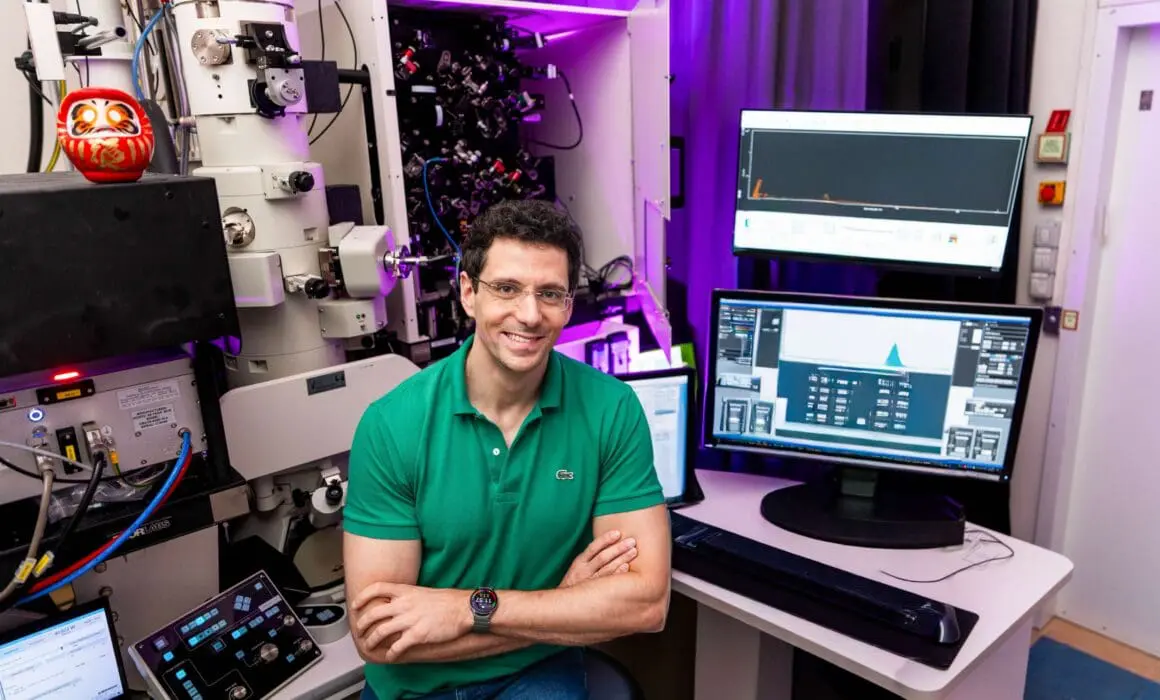
The group, led by Prof. Ido Kaminer, harnessed a cutting-edge electron microscopy technique to directly measure dark points within light waves for the first time — an approach that could reveal many other elusive natural processes.
What are these dark points, exactly? They are essentially tiny “holes” in the wave structure, known as vortices. They are a common phenomenon in nature: we encounter them in ocean waves, in air currents, and even in coffee when we stir it or pour it into the sink.
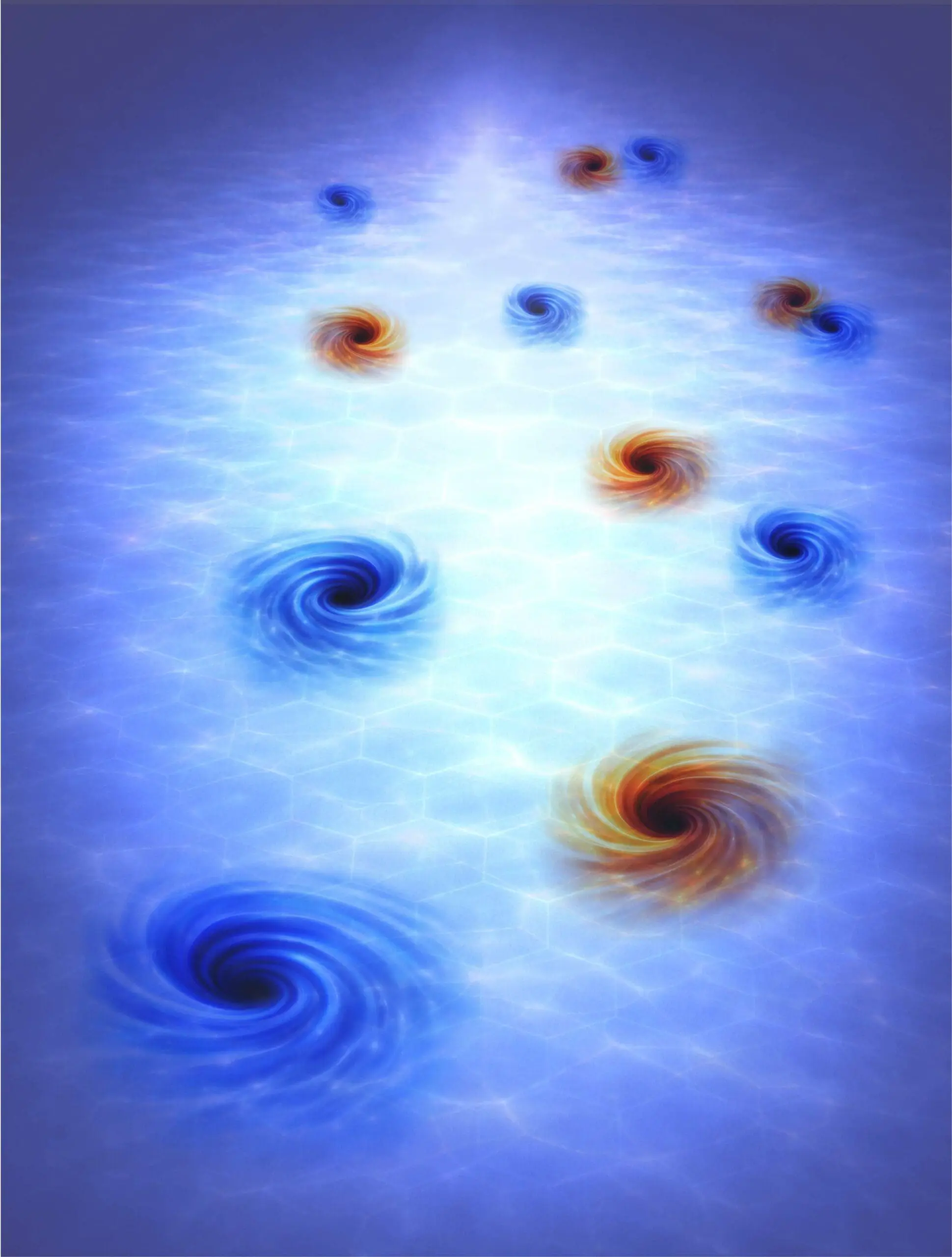
Illustration: A glowing “pool” of light reveals swirling blue and orange vortices, the “dark points” where light intensity vanishes. These features, measured by Technion researchers, can move faster than light without violating relativity, offering new insight into the hidden dynamics of wave phenomena. (Credit : Tomer Bucher)
Scientists have long predicted that these vortices can move faster than the light waves themselves, but demonstrating this experimentally has been challenging.
The Technion team achieved this breakthrough by constructing a unique microscopy system capable of capturing even the fastest and smallest phenomena. By integrating a laser system with an advanced opto-mechanical setup into a specialized electron microscope, the researchers achieved record-breaking temporal and spatial resolution.
“We believe these innovative microscopy techniques will enable the study of hidden processes in physics, chemistry, and biology, revealing for the first time how nature behaves in its fastest and most elusive moments,” said Prof. Kaminer.
The vortices were measured in a specific material (hBN), prepared by Prof. Hanan Herzig Sheinfux of Bar-Ilan University. In this material, light waves become special “light-sound” waves (polaritons). These can be thought of as light waves that move unusually slowly, about 100 times slower than the speed of light in a vacuum, or as sound waves that move unusually fast. It is within these “slowed” waves that light vortices can “leap” and exceed the speed of light.
Importantly, this does not violate the laws of physics: no information or energy is traveling faster than light. Instead, the effect reflects how wave features — like vortices — can shift position faster than the wave itself.
Measuring the rapid “dance” of light vortices opens new scientific directions, with potential impact on the development of microscopy technologies, nanostructure-based optics, superconductivity research, and methods for encoding quantum information in materials.
“Our discovery reveals universal laws of nature shared by all types of waves, from sound waves and fluid flows to complex systems such as superconductors,” said Prof. Kaminer.
The achievement is the result of an extensive international collaboration featuring researchers from the Technion, Bar-Ilan University, MIT, SIOM, Harvard, Stanford University, Milano-Bicocca, and ICFO.