Something Fresh in the State of Denmark
October 06, 2026


















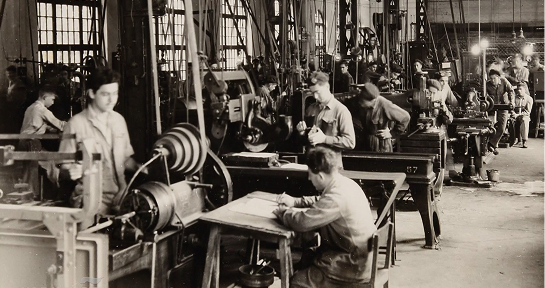
The Technion’s story has been intertwined with Israel’s for more than a century, from laying the foundations for a new nation to shaping its future.

Step inside Israeli innovation at the David and Janet Polak Visitors Center. Experience our 360° immersive movie and tech exhibition. Open to individuals and groups.
Learn More

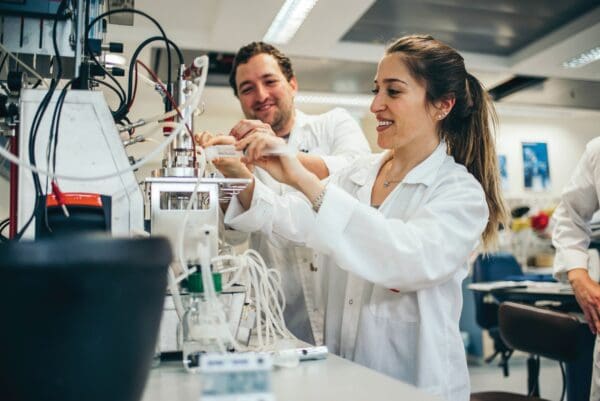
Technion’s Ingenious Approach to Sustainable Food Tech Featuring Professors Marcelle Machluf, Ester Segal,and Uri Lesmes The world’s food system is reaching a crisis point: waste, overfishing, deforestation, greenhouse gas emissions from farming, and more are destroying the planet. As the global population keeps growing, food security is fast becoming one of the major challenges facing […]
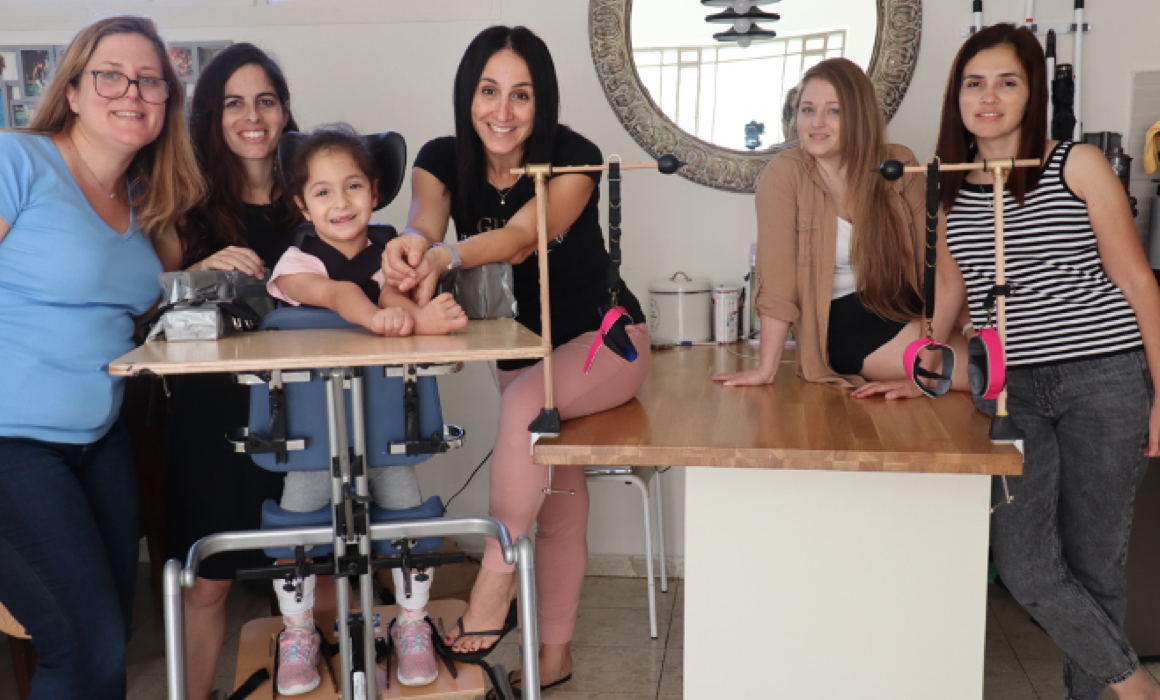
Pictured Above / (Left to right): Hadas Weizman, Sana Gur-Gelbard, Shani Zigman, Orit Zigman, Mor Heinrich, Marina Gabinski Six-year-old Shani has always yearned to draw, but her cerebral palsy has prevented her from lifting her hands independently for tabletop activities. In a heartwarming and inspiring turn of events, four students from the Technion’s Master’s of Industrial Design program teamed up with Shani’s mother to find a solution. They created an award-winning device that enables Shani to draw and eat independently for the first time in her life. “The importance of the device to Shani and the change it has made…
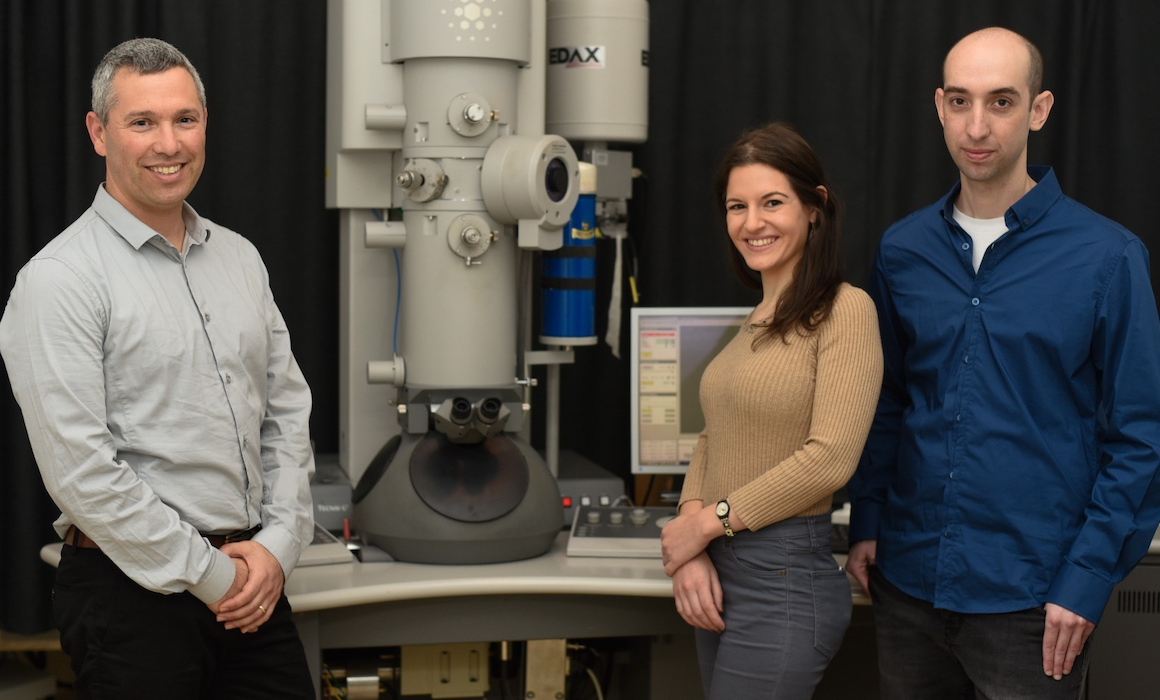
Pictured Above / ( L-R): Professor Yehonadav Bekenstein, Sasha Khalfin, and Noam Veber (Credit : Rami Shelush) What if damaged solar panels or even the cracked screen of your cell phone could heal themselves overnight? Technion scientists have developed self-repairing nanocrystals that might make that scenario a reality. Led by Assistant Professor Yehonadav Bekenstein of the Faculty of Material Sciences and Engineering, the researchers happily stumbled upon the discovery while searching for an environmentally friendly alternative to toxic lead-based perovskites, materials that are commonly used in solar panels. The scientists were using a transmission electron microscope (TEM) to take videos…

Pictured Above / Technion researchers have developed a new method that harvests an electrical current directly from seaweed in an environmentally friendly and efficient fashion. Technion Ph.D. candidate Yaniv Shlosberg was walking on the beach one day when he noticed a rock covered by seaweed that looked like electrical cords. He had been researching a type of bacteria that obtained energy through photosynthesis and thought that maybe this sun-loving seaweed could also produce electrical currents. Using that common seaweed, called Ulva, as a source of energy, Shlosberg and a team of researchers from the Technion and the Israel Oceanographic and…
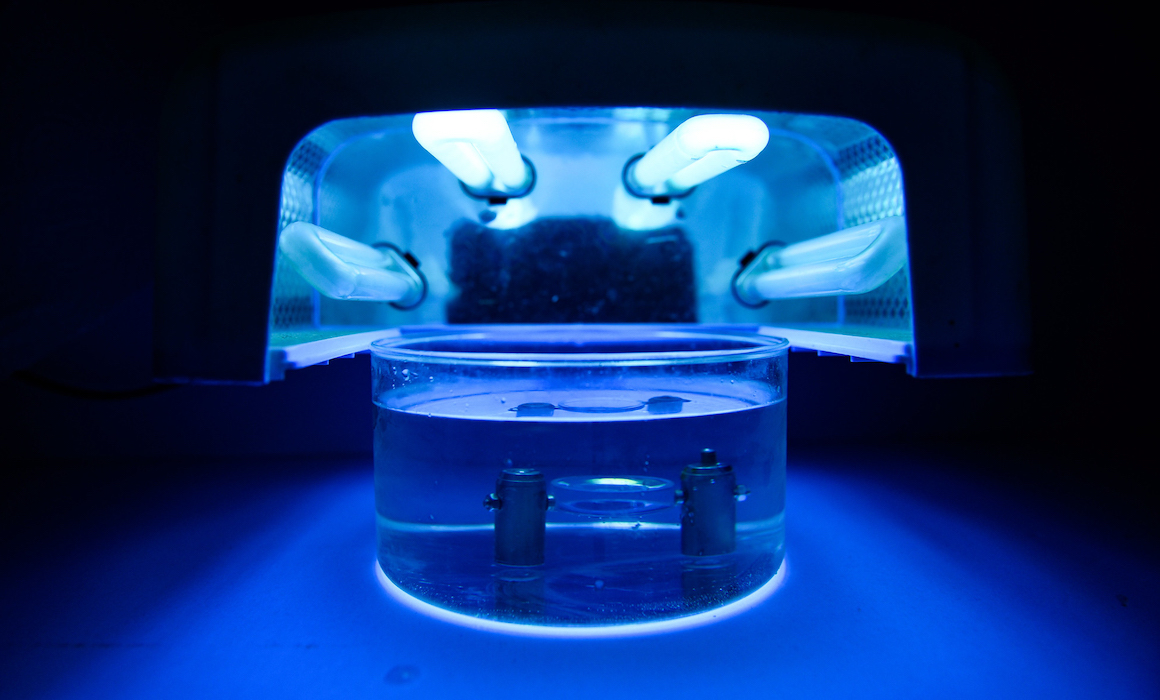
Technion researchers have developed a way to make optical lenses in a cost-effective way. It’s an innovation that could be a gamechanger for 2.5 billion people. It could transform space research. And it all started with a whiteboard and a marker. Although eyeglasses are cheap to make, in many parts of the world, they’re hard to come by. Yet without glasses, children find themselves struggling to follow along in the classroom. Adults lose their jobs because their vision has deteriorated so badly. Faculty of Mechanical Engineering members Professor Moran Bercovici and Dr. Valeri Frumkin became obsessed with this problem. How…


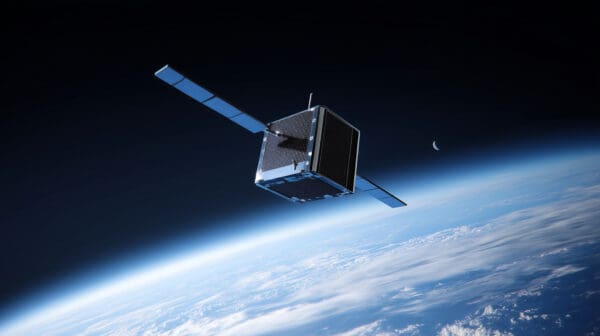
As an ever-increasing number of satellites circle the earth, providing information and services we could not have accessed otherwise. Technion researchers are creating breakthrough experiments to take human knowledge and capability farther than ever before into space. This video premiered during the December 2021 Technion Board of Governors meeting.

We all push the boundaries and cut corners, whether it’s using our cellphone while driving, jaywalking, wearing a mask under our nose or chin, or some other transgression. These minor behavioral violations never make the headlines. Yet even these small infractions can, cumulatively, cause extensive damage to society — with life or death consequences. For example, if no one wears their mask properly, COVID-19 could spread unabated, endangering countless lives. How can society crack down on these behaviors? More frequent enforcement requires more resources like security cameras. More severe punishment for such infractions may lead to public opposition. There’s no…
The National Academy of Inventors and the Intellectual Property Owners Association (collectively known as NAI-IPO) has ranked the Technion – Israel Institute of Technology as one of the top 100 worldwide universities granted U.S. utility patents. The achievement is yet another international recognition of the Technion’s rigorously entrepreneurial and innovative spirit on campus — an ethos that has produced thousands of inventions from both researchers and alumni, including a device that uses AI to detect the scent of more than 23 specific disease biomarkers in a person’s breath, the USB flash drive, and a robotic suit that enables paraplegics to…

Every day, manufacturing companies face costly equipment failures. What if they could detect that leaky valve before it leaked? Alumni-founded Feelit Technologies Ltd. predicts and solves machinery problems before they happen — preventing potentially dangerous equipment failures and reducing the cost of manual inspections and production downtime associated with finding and fixing faults. Feelit technology is based on sensor-packed stickers printed with nanoparticle ink. When affixed to pipes, pumps, or valves, the sensors monitor pressure, temperature, vibration, leakage, wall integrity, thickness, and other industrial parameters. The data is then analyzed in the cloud in real time and sent back to…

Pictured Above / Prof. Mirela Ben-Chen To anyone who’s seen videos of robotic arms in motion, lifting and interlocking parts in construction, it’s clear that computer science has everyday applications. In fact, the use of increasingly sophisticated robots in architectural design and manufacturing is seen as a major technological trend in the construction industry. But while complex architectural projects are often planned on computers, they are executed using construction methods that have remained virtually unchanged for decades. Human intervention is usually necessary, especially when architectural planning is based on complex spatial systems such as thin, doubly curved surfaces, known as…

What’s in store for aerospace engineering in the coming years? A peek at projects being spearheaded by the Technion reveals technology of science fiction caliber, but the next frontier is closer than we think. The Technion’s Faculty of Aerospace Engineering and its Norman and Helen Asher Space Research Institute (ASRI) are exploring impressive projects from a hyper-sonic aircraft that travels at five times the speed of sound to telescopes that self-assemble in space. Often referred to as a “mini-NASA,” the Technion Faculty of Aerospace Engineering is the only department of its kind in Israel and has trained most of the…